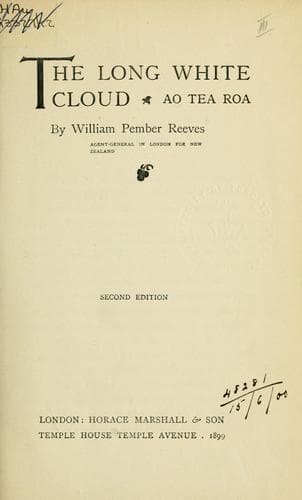
The Long White Cloud: "Ao Tea Roa"Reeves, William Pember
History
The Long White Cloud: "Ao Tea Roa"
Reeves, William Pember
Ethnology -- New Zealand; New Zealand
Colonel Gore Browne took the reins from Colonel Wynyard. The one was
just such an honourable and personally estimable soldier as the other.
But though he did not involve his Parliament in ridicule, Governor
Browne did much more serious mischief. In ordinary matters he took the
advice of the Stafford Ministry, but in Native affairs the Colonial
Office had stipulated that the Governor was to have an over-riding
power. He was to take the advice of his ministers, but not necessarily
to follow it. To most politicians, as well as the public, the Native
Department remained a secret service, though, except as to a sum of
£7,000, the Governor, in administering Native affairs, was dependent
for supplies on his ministers, and they on Parliament. On Governor
Browne, therefore, rests the chief responsibility for a disastrous
series of wars which broke out in 1860, and were not finally at an end
for ten years. The impatience of certain colonists to buy lands from
the Maori faster than the latter cared to sell them was the simple
and not too creditable cause of the outbreak. A broad survey of
the position shows that there need have been no hurry over land
acquisition. Nor was there any great clamour for haste except in
Taranaki, where rather less than 3,000 settlers, restricted to 63,000
acres, fretted at the sight of 1,750 Maoris holding and shutting up
2,000,000 acres against them. So high did feeling run there that
Bishop Selwyn, as the friend of the Maori, was, in 1855, hooted in
the streets of New Plymouth, where the local newspaper wrote nonsense
about his "blighting influence." Yet, as he tersely put it in his
charge to his angry laity of the district guilty of this unmannerly
outburst, the Taranaki Maoris and others of their race had already
sold 30,000 acres near New Plymouth for tenpence an acre, a million of
acres at Napier for a penny three-farthings an acre, the whole of the
territory round Auckland for about fourpence an acre, and the whole
South Island below the Kaikouras for a mite an acre. They had
also--the bishop might have added--leased large tracts ultimately
turned into freeholds. Yet the impatience of the Taranaki settlers,
though mischievous, was natural. The Maoris made no use of a hundredth
part of their lands. Moreover, members of the Taranaki tribes who were
anxious to sell plots to the Whites were threatened, attacked, and
even assassinated by their fellow-tribesmen.
Public-domain text, read in full here on John Shaqi.
Reviews
Reviews
No reviews yet
Be the first to share your thoughts on this work.
Elsewhere in the archive
Join the Discussion
Join the discussion
Sign in to leave a comment or review.
Sign InorCreate an account