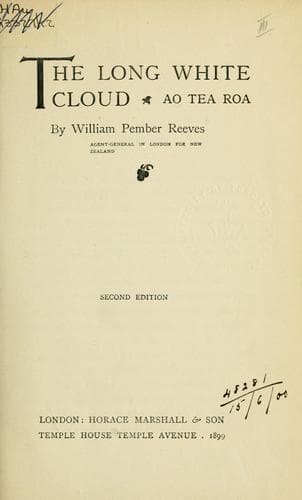
The Long White Cloud: "Ao Tea Roa"Reeves, William Pember
History
The Long White Cloud: "Ao Tea Roa"
Reeves, William Pember
Ethnology -- New Zealand; New Zealand
Never bullied, and not much interfered with by the Government, the
Maori tribes as a whole were prospering. They farmed, and drove a
brisk trade with the settlements, especially Auckland, where, in 1858,
no less than fifty-three coasting vessels were registered as belonging
to Native owners. Still, the growing numbers of the colonists alarmed
them. They saw their race becoming the weaker partner. Originating
in Taranaki, a league was formed by a number of the tribes against
further selling of land. To weld this league together, certain
powerful Waikato chiefs determined to have a king. Of them the most
celebrated was the son of Hongi's old antagonist, Te Waharoa. This
leader, Wiremu Tamihana, usually known as William Thompson, was an
educated Christian and a brown-skinned gentleman, far in advance of
his race in breadth of view, logical understanding, and persistence.
He honestly wanted to be at peace with us, but regarding contact with
our race as deadly to his own, desired to organize the Maori as a
community dwelling apart from the _Pakeha_ on ample and carefully
secured territories. Had the Maori race numbered 500,000 instead
of 50,000, and been capable of uniting under him for any purpose
whatever, he might conceivably have established a counterpart to
Basutoland. But the scanty dwindling tribes could not be welded
together. New Zealand was, as she is, the land of jealousies, local
and personal. It would seem as though every change of wind brought
fresh rivalry and division. The Waikato chiefs themselves were at
odds. After years of argument and speech-making they came to the point
of choosing their king. But they compromised on the old chief, Te
Whero Whero. The once famous warrior was now blind, broken, and
enfeebled. When, in 1860, he died, they made the still greater mistake
of choosing as successor his son Matutaera (Methuselah), better known
as Tawhiao, a dull, heavy, sullen-looking fool, who afterwards became
a sot. They disclaimed hostility to the Queen, but would sell no land,
and would allow no Whites to settle among them except a few mechanics
whose skill they wished to use. They even expelled from their villages
white men who had married Maori wives, and who now had to leave their
families behind. They would not allow the Queen's writ to run beyond
their _aukati_ or frontier, or let boats and steamers come up their
rivers. Amongst themselves the more violent talked of driving the
_Pakeha_ into the sea. Space will not permit of any sketch of the
discussions and negotiations by which attempts were made to deal with
the King Movement. Various mistakes were made. Thompson, while still
open to conciliation, visited Auckland to see the Governor and ask for
a small loan to aid his tribe in erecting a flour-mill. Governor Grey
would have granted both the interview and the money with good grace.
Governor Browne refused both, and the Waikato chief departed deeply
incensed. A much graver error was the virtual repeal of the ordinance
Public-domain text, read in full here on John Shaqi.
Reviews
Reviews
No reviews yet
Be the first to share your thoughts on this work.
Elsewhere in the archive
Join the Discussion
Join the discussion
Sign in to leave a comment or review.
Sign InorCreate an account