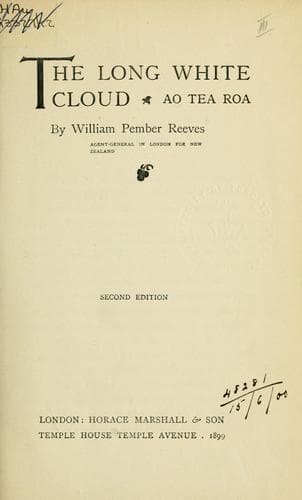
The Long White Cloud: "Ao Tea Roa"Reeves, William Pember
History
The Long White Cloud: "Ao Tea Roa"
Reeves, William Pember
Ethnology -- New Zealand; New Zealand
It was in April, 1864, that they first appeared in the field. A
Captain Lloyd, out with a reconnoitring party in Taranaki, fell,
rather carelessly, into an ambuscade, where he and six of his people
were killed and a dozen wounded. When Captain Atkinson and his rangers
came up at speed to the rescue, they found that the heads of the slain
had been cut off and carried away. Lloyd's, it appears, was carried
about the island by Hau-Hau preachers, who professed to find in it
a kind of diabolical oracle, and used it with much effect in
disseminating their teaching. One of these prophets, or preachers,
however, had a short career. Three weeks after Lloyd's death,
this man, having persuaded himself and his dupes that they were
invulnerable, led them against a strong and well-garrisoned redoubt at
Sentry Hill, between New Plymouth and Waitara. Early one fine morning,
in solid column, they marched deliberately to within 150 yards of the
fort, and before straight shooting undeceived them about the value of
their charms and passes, thirty-four of the poor fanatics were lying
beside their prophet in front of the redoubt. A number more were
carried off hurt or dying, and thenceforward the Taranaki natives were
reduced to the defensive.
In the summer of the same year another prophet met his death in the
most dramatic fight of the war, that by which the friendly natives
of the Wanganui district saved it from a Hau-Hau raid by a conflict
fought on an island in the Wanganui River, after a fashion which would
have warmed the heart of Sir Walter Scott had he been alive to hear
of a combat so worthy of the clansmen in "The Fair Maid of Perth." It
came about a month after the repulse at the Gate _Pa_. For months the
friendlies had been guarding the passage of the river against a strong
Hau-Hau force. At last, tired of waiting, they challenged the enemy to
a fair fight on the island of Moutua. It was agreed that neither
side should attempt to take advantage of the other by surprise or
ambuscade. They landed at opposite ends of the islet. First came the
friendlies, 100 strong; 50 formed their first line under three brave
chiefs; 50 stood in reserve under Haimona (Simon) Hiroti; 150 friends
watched them from one of the river banks. Presently the Hau-Haus
sprang from their canoes on to the river-girt arena, headed by their
warrior-prophet Matené (Martin). After much preliminary chanting of
incantations and shouting of defiance, the Hau-Haus charged. As they
came on, the friendly natives, more than half believing them to be
invulnerable, fired so wildly that every shot missed. Three of the
Wanganui leaders fell, and their line wavered and broke. In vain
a fourth chief, Tamihana, shot a Hau-Hau with each barrel of his
_tupara_, speared a third, and cleft the skull of yet another with
his tomahawk. Two bullets brought him down. It was Haimona Hiroti who
saved the day. Calling on the reserve, he stopped the flying, and,
rallying bravely at his appeal, they came on again.
Public-domain text, read in full here on John Shaqi.
Reviews
Reviews
No reviews yet
Be the first to share your thoughts on this work.
Elsewhere in the archive
Join the Discussion
Join the discussion
Sign in to leave a comment or review.
Sign InorCreate an account