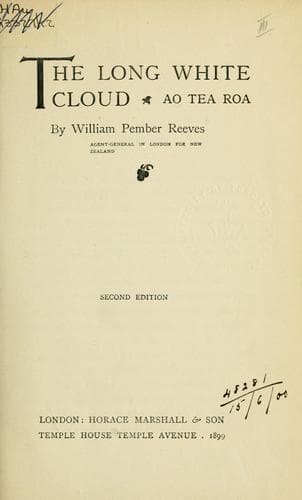
The Long White Cloud: "Ao Tea Roa"Reeves, William Pember
History
The Long White Cloud: "Ao Tea Roa"
Reeves, William Pember
Ethnology -- New Zealand; New Zealand
ranges, wading up the beds of mountain torrents, hacking paths through
the tangled forest, they were ever on his track, only to miss him.
It was in the Uriwera wilderness that Te Kooti lost his congenially
bloodthirsty crony Kereopa, who was caught there and hung. Left almost
without followers, he himself at last took refuge in the King Country,
where he stayed quiet and unmolested. In the end he received a pardon,
and died in peace after living for some twenty years after his hunters
had abandoned their chase.
Colonel Whitmore, crossing to the Wanganui district after the fall of
Ngatapa, had set off to deal with Titokowaru. He, however, threw up
the game and fled to the interior, where he was wisely left alone,
and, except for the fruitless pursuit of Te Kooti, the year 1870 may
be marked as the end of warfare in New Zealand.
The interest of the Maori struggle, thus concluded, does not spring
from the numbers engaged. To a European eye the combats were in point
of size mere battles of the frogs and mice. What gave them interest
was their peculiar and picturesque setting, the local difficulties to
be met, and the boldness, rising at moments to heroism, with which
clusters of badly armed savages met again and again the finest
fighting men of Europe. It was the race conflict which gave dignity
to what Lieutenant Gudgeon in his chronicle truthfully reduces to
"expeditions and skirmishes grandiloquently styled campaigns". Out of
a multitude of fights between 1843 and 1870, thirty-seven (exclusive
of the raid on Poverty Bay, which was a massacre) may be classed as of
greater importance than the rest. Out of these we were unmistakably
beaten nine times, and a tenth encounter, that of Okaihau, was
indecisive. Of twenty-seven victories, however, those of Rangi-riri
and Orakau were dearly bought; in the double fight at Nukumaru we lost
more than the enemy, and at Waireka most of our forces retreated,
and only heard of the success from a distance. Two disasters and six
successes were wholly or almost wholly the work of native auxiliaries.
The cleverness and daring of the Maori also scored in the repeated
escapes of batches of prisoners.
Public-domain text, read in full here on John Shaqi.
Reviews
Reviews
No reviews yet
Be the first to share your thoughts on this work.
Elsewhere in the archive
Join the Discussion
Join the discussion
Sign in to leave a comment or review.
Sign InorCreate an account