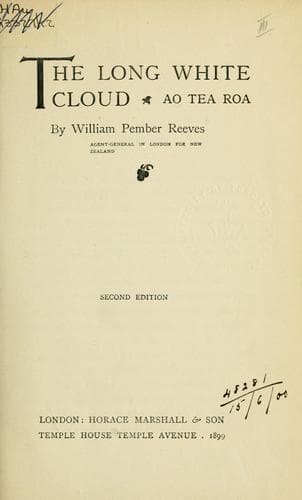
The Long White Cloud: "Ao Tea Roa"Reeves, William Pember
History
The Long White Cloud: "Ao Tea Roa"
Reeves, William Pember
Ethnology -- New Zealand; New Zealand
By 1870 it was possible to try and count the cost of the ten years'
conflict. It was not so easy to do so correctly. The killed alone
amounted to about 800 on the English side and 1,800 on the part of the
beaten natives. Added to the thousands wounded, there had been many
scores of "murders" and heavy losses from disease, exposure and
hardship. The Maoris were, for the most part, left without hope and
without self-confidence. The missionaries never fully regained
their old moral hold upon the race, nor has it shown much zeal and
enthusiasm in industrial progress. On the other side, the colonists
had spent between three and four millions in fighting, and for more
than fifteen years after the war they had to keep up an expensive
force of armed police. There had been destruction of property in
many parts of the North Island, and an even more disastrous loss
of security and paralysis of settlement. Since 1865, moreover, the
pastoral industry in the south had been depressed by bad prices. It
is true that some millions of acres of Maori land had been gained by
confiscation, but of this portions were handed over to loyal natives.
Much more was ultimately given back to the insurgent tribes, and the
settlement of the rest was naturally a tardy and difficult process.
Farmers do not rush upon land to be the mark of revengeful raids. The
opening of the year 1870 was one of New Zealand's dark hours.
Nevertheless, had the colonists but known it, the great native
difficulty was destined to melt fast away. Out of the innumerable
perplexities, difficulties, and errors of the previous generation, a
really capable Native Minister had been evolved. This was Sir Donald
McLean, who, from the beginning of 1869 to the end of 1876, took
the almost entire direction of the native policy. A burly, patient,
kindly-natured Highlander, his Celtic blood helped him to sympathize
with the proud, warlike, clannish nature of the Maori. It was largely
owing to his influence that Ropata and others aided us so actively
against Te Kooti. It was not, however, as a war minister, but as the
man who established complete and lasting peace through New Zealand,
that his name should be remembered. By liberal payment for service, by
skilful land purchases, by showing respect to the chiefs, and tact and
good humour with the people, McLean acquired a permanent influence
over the race. The war party in the Colony might sneer at his "Flour
and Sugar Policy"; but even the dullest had come to see by this time
that peace paid. Into the remnant of the King Country McLean never
tried to carry authority. He left that and the Urewera country further
east discreetly alone. Elsewhere the Queen's writ ran, and roads,
railways, and telegraphs, coming together with a great tide of
settlement, made the era of war seem like an evil dream. It is true
that the delays in redeeming promises concerning reserves to be made
and given back from the confiscated Maori territory were allowed to
Public-domain text, read in full here on John Shaqi.
Reviews
Reviews
No reviews yet
Be the first to share your thoughts on this work.
Elsewhere in the archive
Join the Discussion
Join the discussion
Sign in to leave a comment or review.
Sign InorCreate an account