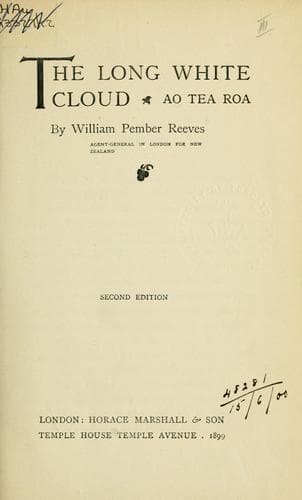
The Long White Cloud: "Ao Tea Roa"Reeves, William Pember
History
The Long White Cloud: "Ao Tea Roa"
Reeves, William Pember
Ethnology -- New Zealand; New Zealand
When peace at last gave the Colonists time to look round, the
constitution which Grey and Wakefield had helped to draw up was still
working. Not without friction, however. Under the provincial system
New Zealand was rather a federation of small settlements than a
unified colony. This was in accord with natural conditions, and with
certain amendments the system might have worked exceedingly well. But
no real attempt was ever made to amend it. Its vices were chiefly
financial. The inequalities and jealousies caused by the rich landed
estate of the southern provinces bred ill-feeling all round. The
irregular grants doled out by the Treasurer to the needier localities
embarrassed the giver without satisfying the recipients. The provinces
without land revenue looked with hungry eyes at those which had it.
There was quarrelling, too, within each little provincial circle. The
elective superintendents were wont to make large promises and shadow
forth policies at the hustings. Then when elected they often found
these views by no means in accord with those of their council and
their executive. Yet, but for one great blunder, the provinces should
and probably would have existed now.
1870 is usually named as the birth-year of the colonial policy of
borrowing and public works. This is not strictly true. In that year
the central and provincial exchequers already owed about seven
millions and a quarter between them. The provincial debts, at any
rate, had been largely contracted in carrying out colonizing work,
and some of that work had been exceedingly well done, especially in
Canterbury and Otago. What the Central Government did do in 1870 was
to come forward boldly with a large and continuous policy of public
works and immigration based on borrowed money. The scheme was Sir
Julius Vogel's. As a politician this gentleman may not unfairly be
defined as an imaginative materialist and an Imperialist of the school
of which Cecil Rhodes is the best-known colonial exponent. His grasp
of finance, sanguine, kindly nature, quick constructive faculty, and
peculiarly persuasive manner rapidly brought him to the front in New
Zealand, in the face of personal and racial prejudice. As Treasurer in
1870 he proposed to borrow ten millions to be expended on railways,
roads, land purchase, immigration, and land settlement. With great
wisdom he suggested that the cost of the railways should be recouped
from a public estate created out of the crown lands through which they
might pass. With striking unwisdom the Provincialists defeated the
proposal. This selfish mistake enabled them to keep their land for
five years longer, but it spoilt the public works policy and converted
Vogel from the friend into the enemy of the Provinces.
Public-domain text, read in full here on John Shaqi.
Reviews
Reviews
No reviews yet
Be the first to share your thoughts on this work.
Elsewhere in the archive
Join the Discussion
Join the discussion
Sign in to leave a comment or review.
Sign InorCreate an account