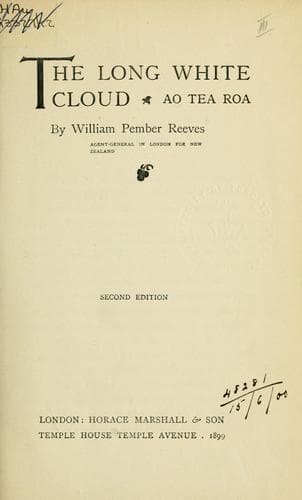
The Long White Cloud: "Ao Tea Roa"Reeves, William Pember
History
The Long White Cloud: "Ao Tea Roa"
Reeves, William Pember
Ethnology -- New Zealand; New Zealand
His policy, _minus_ the essential part relating to land settlement,
was accepted and actively carried out. Millions were borrowed,
hundreds of miles of railways and roads were made, immigrants were
imported by the State or poured in of their own accord. Moreover, the
price of wool had risen, and wheat, too, sometimes yielded enormous
profits. Farmers were known who bought open land on the downs or
plains of the South Island at £2 an acre, and within twelve months
thereafter made a net profit of £5 an acre from their first wheat
crop. Labour-saving machinery from the United States came in to
embolden the growers of cereals; the export of wheat rose to millions
of bushels; and the droning hum of the steam threshing-machine and the
whir of the reaper-and-binder began to be heard in a thousand fields
from northern Canterbury to Southland. In the north McLean steadfastly
kept the peace, and the Colony bade fair to become rich by leaps and
bounds. The modern community has perhaps yet to be found which can
bear sudden prosperity coolly. New Zealand in the seventies certainly
did not. Good prices and the rapid opening up of the country raised
the value of land. Acute men quickly bought fertile or well-situated
blocks and sold them at an attractive profit. So men less acute began
to buy pieces less fertile and not so well situated. Pastoral tenants
pushed on the process of turning their leaseholds into freeholds. So
rapid did the buying become that it grew to be a feverish rush of men
all anxious to secure some land before it had all gone. Of course much
of this buying was speculative, and much was done with borrowed money.
The fever was hottest in Canterbury, where the Wakefield system of
free selection without limit as to area or condition as to occupation,
and with the fixed price of £2 an acre, interposed less than no check
at all to the speculators. Hundreds of thousands of acres were bought
each year. The revenue of the Provincial Council rose to half a
million; the country road-boards hardly knew how to spend their money.
Speculation, extravagance, reaction--such were the fruits the last
years of Wakefield's system bore there. Not that the fault was Gibbon
Wakefield's. It rests with the men who could not see that his system,
like every other devised for a special purpose, wanted to be gradually
changed along with the gradual change of surrounding circumstances.
Public-domain text, read in full here on John Shaqi.
Reviews
Reviews
No reviews yet
Be the first to share your thoughts on this work.
Elsewhere in the archive
Join the Discussion
Join the discussion
Sign in to leave a comment or review.
Sign InorCreate an account