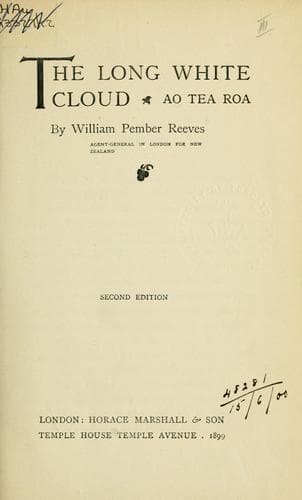
The Long White Cloud: "Ao Tea Roa"Reeves, William Pember
History
The Long White Cloud: "Ao Tea Roa"
Reeves, William Pember
Ethnology -- New Zealand; New Zealand
The southern land revenue, thus swollen, was a glittering temptation
to politicians at Wellington. As early as 1874 it was clear that more
colonial revenue would be wanted to pay the interest on the growing
public debt. Vogel decided to appeal to the old Centralist party and
overthrow the Provinces. Their hour was come. The pastoral tenants
nearly everywhere disliked the democratic note growing louder in some
of them. New settlers were overspreading the country, and to the new
settlers the Provincial Councils seemed cumbrous and needless. Fresh
from Great Britain and with the ordinary British contempt for the
institutions of a small community, they thought it ridiculous that
a colony with less than half a million of people should want nine
Governments in addition to its central authority. The procedure of the
Provincial Councils, where Mr. Speaker took the chair daily and a
mace was gravely laid on the table by the clerk, seemed a Lilliputian
burlesque of the great Mother of Parliaments at Westminster.
Nevertheless, the Provinces did not fall without a struggle. In both
Otago and Auckland the older colonists mostly clung to their local
autonomy. Moreover, Sir George Grey had taken up his abode in the
Colony, and was living quietly in an islet which he owned near
Auckland. Coming out of his retirement, he threw himself into the
fight, and on the platform spoke with an eloquence that took his
audiences by storm, all the more because few had suspected him of
possessing it. Keen was the fight; Major Atkinson, _quondam_ militia
officer of Taranaki, made his mark therein and rose at a bound to take
command of the Centralists; the Provincialists were fairly beaten; the
land passed to the Central Government. The management of local affairs
was minutely subdivided and handed over to some hundreds of boards and
councils which vary a good deal in efficiency, though most of them do
their special work fairly enough on accepted lines.
Public-domain text, read in full here on John Shaqi.
Reviews
Reviews
No reviews yet
Be the first to share your thoughts on this work.
Elsewhere in the archive
Join the Discussion
Join the discussion
Sign in to leave a comment or review.
Sign InorCreate an account