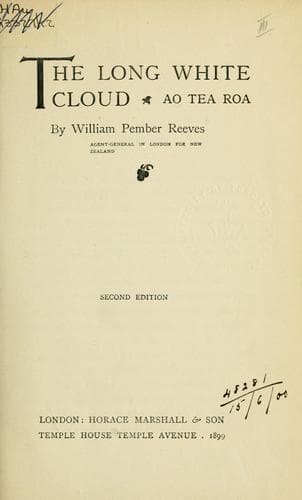
The Long White Cloud: "Ao Tea Roa"Reeves, William Pember
History
The Long White Cloud: "Ao Tea Roa"
Reeves, William Pember
Ethnology -- New Zealand; New Zealand
"Shapes of all sorts and sizes, great and small
That stood upon the floor or by the wall,
And some loquacious Vessels were, and some
Listened, perhaps, but never talked at all."
When we come to look at the men as distinct from the measures of the
parliament of New Zealand between 1870 and 1890, perhaps the most
interesting and curious feature was the Continuous Ministry. With
some approach to accuracy it may be said to have come into office in
August, 1869, and to have finally expired in January, 1891. Out of
twenty-one years and a half it held office for between sixteen and
seventeen years. Sir Edward Stafford turned and kept it out for a
month in 1872; Sir George Grey for two years, 1877-79; Sir Robert
Stout for three years, 1884-7. None of the ministries which thus
for longer or shorter periods supplanted it ever commanded strong
majorities, or held any thorough control over the House. The
Continuous Ministry was a name given to a shifting combination, or
rather series of combinations, amongst public men, by which the
cabinet was from time to time modified without being completely
changed at any one moment. It might be likened to the pearly nautilus,
which passes, by gradual growth and movement, from cell to cell in
slow succession; or, more prosaically, to that oft-repaired garment,
which at last consisted entirely of patches. Like the nautilus, too,
it had respectable sailing and floating powers. The continuous process
was rather the outcome of rapidly changing conditions and personal
exigencies than of any set plan or purpose. With its men its
opinions and actions underwent alterations. Naturally the complete
transformation which came over the Colony during the two decades
between 1870 and 1890, had its effect on the point of view of
colonists and their public men. The Continuous Ministry began by
borrowing, and never really ceased to borrow; but its efforts at
certain periods of the second of these two decades to restrict
borrowing and retrench ordinary expenditure were in striking contrast
to the lavishness of the years between 1872 and 1877. At its birth
under Sir William Fox its sympathies were provincial and mildly
democratic. It quickly quarrelled with and overthrew the Provinces,
and became identified with Conservatism as that term is understood
in New Zealand. From 1869 to 1872 its leaders were Fox, Vogel, and
McLean. Fox left it in 1872; Major Atkinson joined it in 1874; Vogel
quitted it in 1876; McLean died in 1877. Put out of office by Sir
George Grey, it was for a short time led once more by Sir William Fox.
It came back again in 1879 as a Hall-Atkinson-Whitaker combination.
Hall retired in 1881, but Atkinson and Whitaker, helped by his advice,
continued to direct it to the end.
Public-domain text, read in full here on John Shaqi.
Reviews
Reviews
No reviews yet
Be the first to share your thoughts on this work.
Elsewhere in the archive
Join the Discussion
Join the discussion
Sign in to leave a comment or review.
Sign InorCreate an account