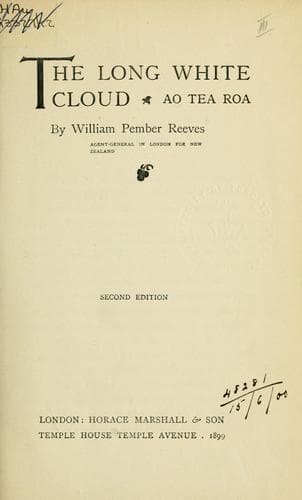
The Long White Cloud: "Ao Tea Roa"Reeves, William Pember
History
The Long White Cloud: "Ao Tea Roa"
Reeves, William Pember
Ethnology -- New Zealand; New Zealand
Now for its opponents. Rallying under Sir George Grey in 1876, the
beaten Provincialists formed a party of progress, taking the good old
name of Liberal. Though Sir George had failed to save their
Provinces, his eloquent exhortations rapidly revived in the House of
Representatives the democratic tendencies of some of the Councils.
Hitherto any concessions to Radicalism or Collectivism made by the
House had been viewed in the most easy-going fashion. Vogel in his
earlier years had adopted the ballot, and had set up a State Life
Insurance Department, which has been successfully managed, and has now
about ten millions assured in it. More interesting and valuable still
was his establishment of the office of Public Trustee. So well has the
experiment worked, that it may be said as a plain truth that in New
Zealand, the best possible Trustee, the one least subject to accidents
of fortune, and most exempt from the errors which beset man's honesty
and judgment, has been found by experience to be the State. The Public
Trust Office of the Colony worked at first in a humble way, chiefly in
taking charge of small intestate estates. Experience, however, showed
its advantages so clearly, that it has now property approaching two
millions' worth in its care. Any owner of property, whether he be
resident in the Colony or not, wishing to create a trust, may use the
Public Trustee, subject, of course, to that officer's consent. Any one
who desires so to do may appoint him the executor of his will. Any one
about to leave, or who has left the Colony, may make him his attorney.
The Public Trustee may step in and take charge, not only of intestate
estates, but of an inheritance where no executor has been named under
the will, or where those named will not act. He manages and protects
the property of lunatics. Where private trust estates become the cause
of disputes and quarrels, between trustees and beneficiaries, the
parties thereto may relieve themselves by handing over their burden to
the public office. The Public Trustee never dies, never goes out of
his mind, never leaves the Colony, never becomes disqualified, and
never becomes that extremely disagreeable and unpleasant person--a
trustee whom you do not trust. In addition to his other manifold
duties he holds and administers very large areas of land reserved for
the use of certain Maori tribes. These he leases to working settlers,
paying over the rents to the Maori beneficiaries. Naturally, the class
which has the most cause to be grateful to the Public Trust Office
is that composed of widows and orphans and other unbusinesslike
inheritors of small properties, persons whose little inheritances are
so often mismanaged by private trustees or wasted in law costs.
Public-domain text, read in full here on John Shaqi.
Reviews
Reviews
No reviews yet
Be the first to share your thoughts on this work.
Elsewhere in the archive
Join the Discussion
Join the discussion
Sign in to leave a comment or review.
Sign InorCreate an account