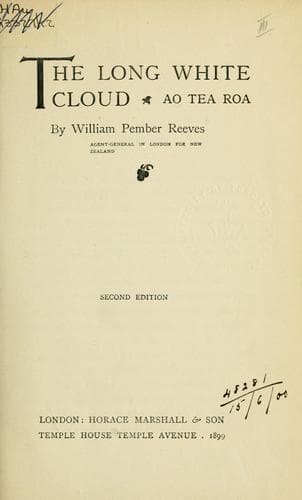
The Long White Cloud: "Ao Tea Roa"Reeves, William Pember
History
The Long White Cloud: "Ao Tea Roa"
Reeves, William Pember
Ethnology -- New Zealand; New Zealand
Grey gained office in 1877, but with a majority too small to enable
him to carry his measures. Ballance, his treasurer, did indeed carry
a tax upon land values. But its chief result at the time was to
alarm and exasperate owners of land, and to league them against the
Radicals, who after a not very brilliant experience of office without
power fell in 1879. Thereafter, so utterly had Grey's angry followers
lost faith in his generalship, that they deposed him--a humiliation
which it could be wished they had seen their way to forego, or he to
forgive. Yet he was, it must be confessed, a very trying leader. His
cloudy eloquence would not do for human nature's daily food. His
opponents, Atkinson and Hall, had not a tithe of his emotional power,
but their facts and figures riddled his fine speeches. Stout and
Ballance, lieutenants of talent and character, became estranged from
him; others of his friends were enough to have damned any government.
The leader of a colonial party must have certain qualities which Sir
George Grey did not possess. He may dispense with eloquence, but must
be a debater; whether able or not able to rouse public meetings,
he must know how to conduct wearisome and complicated business by
discussion; he must not only have a grasp of great principles, but
readiness to devote himself to the mastery of uninteresting minds and
unappetizing details; above all, he must be generous and considerate
to lieutenants who have their own views and their own followers, and
who expect to have their full share of credit and influence. In one
word, he should be what Ballance was and Grey was not. Nevertheless,
one of Grey's courage, talent, and prestige was not likely to fail to
leave his mark upon the politics of the country; nor did he. Though he
failed to pass the reforms just mentioned, he had the satisfaction of
seeing them adopted and carried into law, some by his opponents, some
by his friends. Only one of his pet proposals seems to have been
altogether lost sight of, his oft-repeated demand that the Governor of
the Colony should be elected by the people.
The Grey Ministry had committed what in a Colonial Cabinet is the one
unpardonable crime--it had encountered a commercial depression, with
its concomitant, a shrunken revenue. When Hall and Atkinson succeeded
Grey with a mission to abolish the land-tax, they had at once to
impose a different but more severe burden. They also reduced--for a
time--the cost of the public departments by the rough-and-ready method
of knocking ten per cent. off all salaries and wages paid by the
treasury, a method which, applied as it was at first equally to low
and high, had the unpopularity as well as the simplicity of the
poll-tax. That retrenchment and fresh taxation were unpleasant
necessities, and that Hall and Atkinson more than once tackled the
disagreeable task of applying them, remains true and to their credit.
Public-domain text, read in full here on John Shaqi.
Reviews
Reviews
No reviews yet
Be the first to share your thoughts on this work.
Elsewhere in the archive
Join the Discussion
Join the discussion
Sign in to leave a comment or review.
Sign InorCreate an account