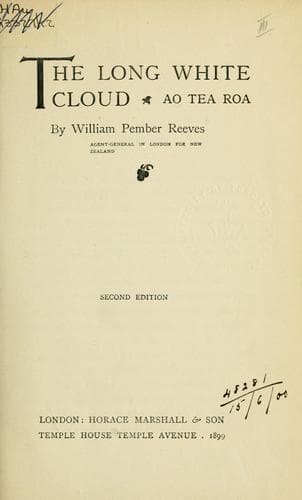
The Long White Cloud: "Ao Tea Roa"Reeves, William Pember
History
The Long White Cloud: "Ao Tea Roa"
Reeves, William Pember
Ethnology -- New Zealand; New Zealand
Between 1880 and 1890 the colonists were for the most part resolutely
at work adapting themselves to the new order of things--to lower
prices and slower progress. They increased their output of wool and
coal--the latter a compensation for the falling-off of the gold. They
found in frozen meat an export larger and more profitable than wheat.
Later on they began, with marked success, to organize co-operative
dairy factories and send cheese and butter to England. Public affairs
during the decade resolved themselves chiefly into a series of
expedients for filling the treasury and carrying on the work of land
settlement. Borrowing went on, but more and more slowly. Times did not
soon get better.
In 1885 and 1886 the industrial outlook was perhaps at its worst. In
1887, Atkinson and Whitaker, coming again into power, with Hall as
adviser, administered a second dose of taxation-cum-retrenchment. They
cut down the salaries of the Governor and the ministers, and the size
and pay of the elected chamber. They made efforts, more equitable this
time, to reduce the cost of the public departments. They stiffened
the property-tax, and for the second time raised the Customs Duties,
giving them a distinctly Protectionist complexion. The broad result
was the achievement of financial equilibrium. For ten years there have
been no deficits in New Zealand. Apart from retrenchment, Atkinson had
to rely upon the Opposition in forcing his financial measures through
against the Free Traders amongst his own following. This strained his
party. Moreover, in forming his cabinet in 1887 he had not picked some
of his colleagues well. In particular, the absence of Mr. Rolleston's
experience and knowledge from the House and the government weakened
him. Mr. Rolleston has his limitations, and his friends did the enemy
a service when, after his return to public life in 1891, they tried to
make a guerilla chief out of a scrupulous administrator. But he was
a capable and not illiberal minister of lands, and his value at that
post to his party may be gauged by what they suffered when they had
to do without him. The lands administration of the Atkinson cabinet
became unpopular, and the discontent therewith found a forcible
exponent in an Otago farmer, Mr. John McKenzie, a gigantic Gael, in
grim earnest in the cause of close settlement, and whose plain-spoken
exposures of monopoly and "dummyism" not only woke up the Radicals,
but went home to the smaller settlers far and wide. It may be that
these things hastened the breaking-down of Sir Harry Atkinson's health
in 1890. At any rate fail it did, unhappily. His colleague, Sir
Frederick Whitaker, was ageing palpably. Nor did Sir John Hall's
health allow him to take office.
[Illustration: THE HON. JOHN MACKENZIE
_By permission of_ Messrs. SAMPSON LOW]
Public-domain text, read in full here on John Shaqi.
Reviews
Reviews
No reviews yet
Be the first to share your thoughts on this work.
Elsewhere in the archive
Join the Discussion
Join the discussion
Sign in to leave a comment or review.
Sign InorCreate an account