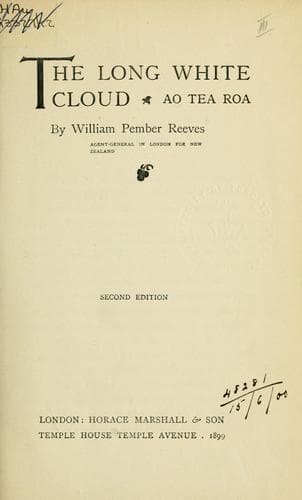
The Long White Cloud: "Ao Tea Roa"Reeves, William Pember
History
The Long White Cloud: "Ao Tea Roa"
Reeves, William Pember
Ethnology -- New Zealand; New Zealand
What kind of an assembly, it may be asked, is the New Zealand
Parliament which Atkinson's force of character enabled him to lead so
long, and which has borne undivided rule over the Colony since 1876?
The best answer can be found in the story of the Colony, for the
General Assembly, at all events, has never been a _fainéant_ ruler.
It has done wrong as well as right, but it has always done something.
After the various false starts before referred to, it has, since
getting fairly to work in 1856, completed forty-three years of talk,
toil, legislation and obstruction. It may fairly be claimed that its
life has been interesting, laborious and not dishonourable. It has
exactly doubled in size since Governor Wynyard's day. Old settlers say
that it has not doubled in ability. But old settlers, with all their
virtues, are incorrigible _laudatores temporis acti_. The industry
of the members, the difficulties they had to cope with in the last
generation, and the number and variety and novelty of the questions
they have essayed to solve in this, are undoubted. Their work must, of
course, be tested by time. Much of it has already borne good fruit,
and any that does manifest harm is not likely to cumber the earth
long. If laws in colonies are more quickly passed, they are also more
easy to amend than in older countries.
The Lower House of a Colonial Parliament resembles, in most ways,
the London County Council more than the House of Commons. But in New
Zealand members have always been paid--their salary is now £240 a
year. Farmers and professional men make up the largest element. The
Labour members have never numbered more than half a dozen. At present
there are five in each House. In the more important debates speeches
are now limited to an hour, otherwise to half an hour. The length of
speeches in committee must not exceed ten minutes. About twenty per
cent. of the speaking is good; most of it is made with little or no
preparation, and suffers--together with its hearers--accordingly.
Bores are never shouted or coughed down--the House is too small, and
nearly all the members are on friendly terms with each other. Until
the adoption of the time limit business was in daily danger of being
arrested by speeches of phenomenal length and dreariness. Anthony
Trollope, who listened to a debate at Wellington in 1872, thought
the New Zealand parliamentary bores the worst he had known. The
discussions in Committee are often admirably businesslike, except when
there is obstruction, as there frequently is. As elsewhere, special
committees do much work and get little thanks therefor. As compared
with the House of Commons, the debates would seem to lack dignity; as
compared with the proceedings of the Sydney Parliament, they would
have appeared models of decorum, at any rate until quite recently. No
New Zealand debater would be held great in England, but seven or eight
would be called distinctly good. The House supports a strong Speaker,
Public-domain text, read in full here on John Shaqi.
Reviews
Reviews
No reviews yet
Be the first to share your thoughts on this work.
Elsewhere in the archive
Join the Discussion
Join the discussion
Sign in to leave a comment or review.
Sign InorCreate an account