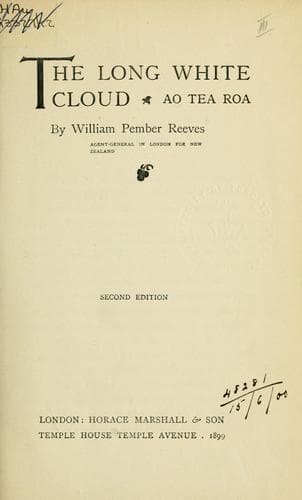
The Long White Cloud: "Ao Tea Roa"Reeves, William Pember
History
The Long White Cloud: "Ao Tea Roa"
Reeves, William Pember
Ethnology -- New Zealand; New Zealand
but is disposed to bully weakness in the chair.
For the last thirty years the Maori race has returned four members
to the House. They usually speak through an interpreter. In spite of
that, when discussing native questions they often show themselves
fluent and even eloquent. Outside local and private bills, nearly all
important legislation is conducted by Government. Private members
often profess to put this down to the jealousy and tyranny of
Ministers, but the truth is that Parliament, as a whole, has always
been intolerant of private members' bills. There is no direct personal
corruption. If the House were as free from small-minded jealousy and
disloyalty as it is from bribery and idleness, it would be a very
noble assembly. In character, the politicians have been at least equal
to the average of their fellow-colonists. But party ties are much
looser than in England. Members will sometimes support Governments for
what they can get for their districts, or leave them because they
have not been given a portfolio. Attempts to form a third party are
incessant but unsuccessful. Ministries, if not strangled at the
birth--as was the "Clean Shirt" Cabinet--usually last for three years.
Since August, 1884, there have virtually been but two changes of the
party in power. Reconstructions owing to death or retirement of a
Premier have now and then added to the number of apparently new
Cabinets. Of the seven or eight Ministers who make up a Cabinet, four
or five are usually able and overworked men. The stress of New Zealand
public life has told on many of her statesmen. Beside Governor Hobson,
McLean, Featherston, Crosbie Ward, Atkinson and Ballance died in
harness, and Hall had to save his life by resigning. Most of the
Colony's leaders have lived and died poor men. Parliaments are
triennial, and about one-third of the constituencies are pretty
certain to return new members at a general election. All the elections
take place on one day, and if a member--even the leader of a
party--loses his seat, he may be cut out for years. This is a
misfortune, as experience is a quality of which the House is apt to
run short. Block votes frequently prevent elections from being fought
on the practical questions of the hour. The contests are inexpensive,
and there is very little of the cynical blackmailing of candidates and
open subsidising by members which jar so unpleasantly on the observer
of English constituencies. Indeed, cynicism is by no means a fault of
New Zealand political life. The most marked failings are, perhaps, the
savagely personal character of some of its conflicts, and a general
over-strained earnestness and lack of sense of proportion or humour.
Newspapers and speeches teem with denunciations which might have been
in place if hurled at the corruption of Walpole, the bureaucracy of
Prussia, the finance of the _Ancien Régime_, or the treatment of
native races by the Spanish conquerors of the New World. Nor is
Public-domain text, read in full here on John Shaqi.
Reviews
Reviews
No reviews yet
Be the first to share your thoughts on this work.
Elsewhere in the archive
Join the Discussion
Join the discussion
Sign in to leave a comment or review.
Sign InorCreate an account