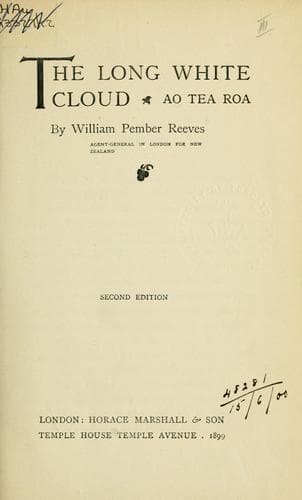
The Long White Cloud: "Ao Tea Roa"Reeves, William Pember
History
The Long White Cloud: "Ao Tea Roa"
Reeves, William Pember
Ethnology -- New Zealand; New Zealand
bitterness confined to wild language in or out of parliament. The
terrible saying of Gibbon Wakefield, fifty years ago, that in Colonial
politics "every one strikes at his opponent's heart," has still
unhappily some truth in it. The man who would serve New Zealand in any
more brilliant fashion than by silent voting or anonymous writing must
tread a path set with the thorns of malice, and be satisfied to find a
few friends loyal and a few foes chivalrous.
Chapter XXI
SOME BONES OF CONTENTION
"Now who shall arbitrate?
Ten men love what I hate,
Shun what I follow, slight what I receive;
Ten who in ears and eyes
Match me; we all surmise,
They this thing, and I that; whom shall my soul believe?"
During the ten years beginning in 1879 New Zealand finance was little
more than a series of attempts to avert deficits. In their endeavours
to raise the revenue required for interest payments on the still
swelling public debt, and the inevitably growing departmental
expenditure, various treasurers turned to the Customs. In raising
money by duties they received support both from those who wished to
protect local industries and from those who wished to postpone the
putting of heavy taxation upon land. Sir Harry Atkinson, the treasurer
who carried the chief protectionist duties, used to disclaim being
either a protectionist or a free-trader. The net result of various
conflicts has been a tariff which is protectionist, but not highly
protectionist. The duties levied on New Zealand imports represent
twenty-four per cent. of the declared value of the goods. But the
highest duties, those on spirits, wine, beer, sugar, tea, and tobacco,
are not intentionally protectionist; they are simply revenue duties,
though that on beer has undoubtedly helped large and profitable
colonial breweries to be established. English free-traders accept as
an axiom that Customs duties cannot produce increased revenue and at
the same time stimulate local manufactures. Nevertheless, under the
kind of compromise by which duties of fifteen, twenty, and twenty-five
per cent. are levied on so many articles, it does come about that the
colonial treasurer gets his revenue while, sheltered by the fiscal
hedge, certain colonial manufactures steadily grow up. The factories
of the Colony now employ some 40,000 hands, and their annual output
is estimated at ten millions sterling. Much of this would, of course,
have come had the Colony's ports been free; but the factories engaged
in the woollen, printing, clothing, iron and steel, tanning, boot,
furniture, brewing, jam-making, and brick and tile-making industries
owe their existence in the main to the duties. Nor would it be fair to
regard the Colony's protection as simply a gigantic job managed by the
more or less debasing influence of powerful companies and firms. It
was adopted before such influences and interests were. It could not
have come about, still less could it last, were there not an honest
Public-domain text, read in full here on John Shaqi.
Reviews
Reviews
No reviews yet
Be the first to share your thoughts on this work.
Elsewhere in the archive
Join the Discussion
Join the discussion
Sign in to leave a comment or review.
Sign InorCreate an account