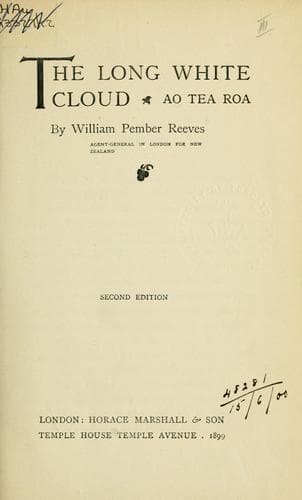
The Long White Cloud: "Ao Tea Roa"Reeves, William Pember
History
The Long White Cloud: "Ao Tea Roa"
Reeves, William Pember
Ethnology -- New Zealand; New Zealand
Much the largest of the estates purchased by the Government came into
their hands in an odd way, and not under the Act just described. The
Cheviot property was an excellent example of what the old cheap-land
regulations led to. It was a fine tract of 84,000 acres of land, on
which up to 1893 some forty human beings and about 60,000 sheep were
to be found. Hilly but not mountainous, grassy, fertile, and lying
against the sea-shore, it was exactly suited for fairly close
settlement. Under the provisions of the land-tax presently to be
described, a landowner who thinks the assessors have over-valued his
property may call upon the Government to buy it at his own lower
valuation. A difference of £50,000 between the estimate of the
trustees who held the Cheviot estate and that of the official valuers
caused the former to give the Government of the day the choice between
reducing the assessment or buying the estate. Mr. McKenzie, however,
was just the man to pick up the gauntlet thus thrown down. He had the
Cheviot bought, cut up, and opened by roads. A portion was sold,
but most leased; and within a year of purchase a thriving yeomanry,
numbering nearly nine hundred souls and owning 74,000 sheep, 1,500
cattle, and 500 horses, were at work in the erstwhile empty tract.
Four prosperous years have since added to their numbers, and the rent
they pay more than recoups the Treasury for the interest on its outlay
in the purchase and settlement.
In 1886, John Ballance, then Minister of Lands, made a courageous
endeavour to place a number of workmen out of employment on the soil
in what were known as village settlements. In various parts of the
Colony blocks of Crown land were taken and divided into allotments of
from twenty to fifty acres. These were let to the village settlers on
perpetual lease at a rental equal to five per cent. on the prairie
value of the land. Once in a generation there was to be a revision
of the rental. The settlers, many of whom were quite destitute, were
helped at first not only by two years' postponement of their rent, but
by small advances to each to enable them to buy seed, tools, food,
and building material. Ballance was fiercely attacked in 1887 for his
experiment, and his opponents triumphantly pointed to the collapse
of certain of his settlements. Others, however, turned out to be
successes, and by last accounts the village settlers and their
families now number nearly five thousand human beings, occupying
35,000 acres in allotments of an average size of twenty-four acres.
Most of them divide their time between tilling their land and working
for wages as shearers, harvesters, or occasionally mechanics. Some
£27,000 has been lent them, of which they still owe about £24,000.
As against this the Government has been paid £27,000 in rent and
interest, and the improvements made by the settlers on their
allotments are valued at about £110,000, and form very good security
for their debts to the Treasury. Of late years Mr.
Public-domain text, read in full here on John Shaqi.
Reviews
Reviews
No reviews yet
Be the first to share your thoughts on this work.
Elsewhere in the archive
Join the Discussion
Join the discussion
Sign in to leave a comment or review.
Sign InorCreate an account