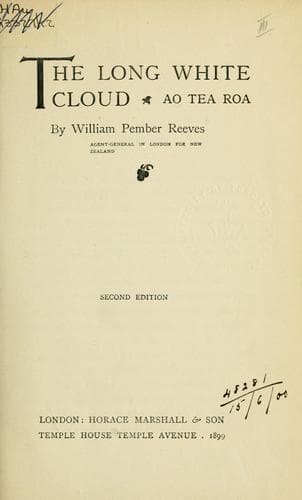
The Long White Cloud: "Ao Tea Roa"Reeves, William Pember
History
The Long White Cloud: "Ao Tea Roa"
Reeves, William Pember
Ethnology -- New Zealand; New Zealand
McKenzie has been
aiding the poorer class of would-be farmers by employing them at wages
to clear the land of which they afterwards become tenants. The money
paid them is, of course, added to the capital value of the land.
For the last five years Liquor has disputed with Land the chief place
in the public interest. It has introduced an element of picturesque
enthusiasm and, here and there, a passion of hatred rarely seen before
in New Zealand politics. It brought division into the Liberal Party
in 1893, at the moment when the Progressive movement seemed to have
reached its high-water mark, and the feeling it roused was found
typified in the curious five years' duel between Mr. Seddon and Sir
Robert Stout, which began in 1893 and ended only with Sir Robert's
retirement at the beginning of the present year. It has strangely
complicated New Zealand politics, is still doing so, and is the key to
much political manoeuvring with which it might seem to have nothing
whatever to do.
For many years total abstainers in New Zealand have grown in numbers.
Though for the last thirty years drinking and drunkenness have been on
the decline among all classes of colonists, and though New Zealanders
have for a long time consumed much less alcohol per head than Britons
do, that has not checked the growth of an agitation for total
prohibition, which has absorbed within itself probably the larger,
certainly the more active, section of temperance reformers.[1] In 1882
a mild form of local option went on to the statute-book, while the
granting of licenses was handed over to boards elected by ratepayers.
For the next ten years no marked result roused attention. Then, almost
suddenly, the Prohibition movement was seen to be advancing by leaps
and bounds. Two clergymen, the Rev. Leonard Isitt and the Rev.
Edward Walker, were respectively the voice and the hand of the
Prohibitionists. As a speaker Mr. Isitt would perhaps be the better
for a less liberal use of the bludgeon, but his remarkable energy and
force on the platform, and his bold and thorough sincerity, made him
a power in the land. Mr. Walker had much to do with securing tangible
results for the force which Mr. Isitt's harangues aroused, and in
which the Liberal Party was to a large extent enrolled. In 1893 the
temperance leaders thought themselves strong enough to make sweeping
demands of Parliament. Ballance, the Liberal Premier, had just died;
his party was by many believed to be disorganized. In Sir Robert
Stout, the Brougham of New Zealand public life, the Prohibitionists
had a spokesman of boundless energy and uncommon hitting power in
debate. He tabled a Bill briefly embodying their complete demands, and
it was read a second time. Old parliamentary hands knew full well that
the introduction of so controversial and absorbing a measure in the
last session before a General Election meant the sacrifice for that
year, at least, of most of the policy bills on labour, land, and
other matters.
Public-domain text, read in full here on John Shaqi.
Reviews
Reviews
No reviews yet
Be the first to share your thoughts on this work.
Elsewhere in the archive
Join the Discussion
Join the discussion
Sign in to leave a comment or review.
Sign InorCreate an account