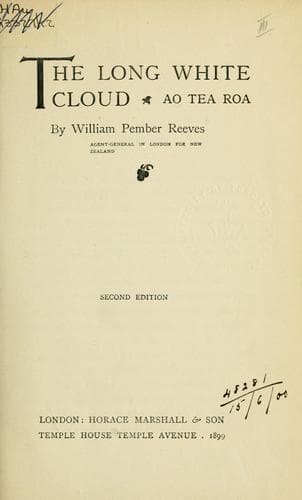
The Long White Cloud: "Ao Tea Roa"Reeves, William Pember
History
The Long White Cloud: "Ao Tea Roa"
Reeves, William Pember
Ethnology -- New Zealand; New Zealand
Anything like a detailed history of the struggles which followed would
be out of place here. Nor is it possible yet to sum up the results of
changes, none of which are eight years old. A mere enumeration of them
would take some space: a succinct description would require a fairly
thick pamphlet. Some were carried after hot debate; some after very
little. Some were resolutely contested in the popular chamber, and
were assented to rather easily in the Upper House; others went through
the Lower House without much difficulty, but failed again and again to
run the gauntlet of the nominated chamber. The voting of some was on
strict party lines: in other instances leading Opposition Members like
Captain Russell frankly accepted the principle of measures. Some were
closely canvassed in the newspapers and country; others were hardly
examined outside Parliament. But, roughly speaking, the chief
experiments of the last eight years not already dealt with many
be divided into three sections. These relate to (1) Finance; (2)
Constitutional Reform; (3) Labour. One of the first and--to a New
Zealander's eyes--boldest strokes delivered was against the Property
Tax. This, the chief direct tax of the Colony, was an annual impost of
1d. in the £ on the capital value of every citizen's possessions, less
his debts and an exemption of £500. Its friends claimed for this tax
that it was no respecter of persons, but was simple, even-handed, and
efficient. The last it certainly was, bringing as it did into the
Treasury annually about as many thousands as there are days in the
year. But inasmuch as different kinds of property are by no means
equally profitable, and therefore the ability of owners to pay is by
no means equal, the simplicity of the Property Tax was not by many
thought equity. The shopkeeper, taxed on unsaleable stock, the
manufacturer paying on plant and buildings as much in good years as in
bad, bethought them that under an Income Tax they would at any rate
escape in bad seasons when their income might be less or nothing.
The comfortable professional man or well-paid business manager paid
nothing on their substantial and regular incomes. The working-farmer
settling in the desert felt that for every pound's worth of
improvements made by muscle and money he would have to account to the
tax-collector at the next assessment. Nevertheless the Conservative
politicians rallied round the doomed tax. It was a good machine for
raising indispensable revenue. Moreover, it did not select any class
of property-owners or any description of property for special burdens.
This suited the landowners, who dreaded a Land Tax, for might not a
Land Tax contain the germ of that nightmare of the larger colonial
landowner--the Single Tax? It suited also the wealthy, who feared
graduated taxation, and the lawyers, doctors, agents, and managing
directors, whose incomes it did not touch. So when in the autumn the
rumour went round that the Ballance Ministry meant to abolish the
Public-domain text, read in full here on John Shaqi.
Reviews
Reviews
No reviews yet
Be the first to share your thoughts on this work.
Elsewhere in the archive
Join the Discussion
Join the discussion
Sign in to leave a comment or review.
Sign InorCreate an account