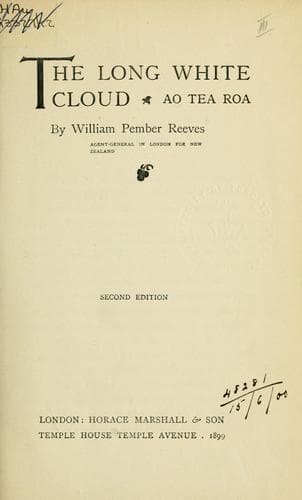
The Long White Cloud: "Ao Tea Roa"Reeves, William Pember
History
The Long White Cloud: "Ao Tea Roa"
Reeves, William Pember
Ethnology -- New Zealand; New Zealand
Property Tax and bring forward Bills embodying a Progressive Land Tax,
and Progressive Income Tax, the proposal was thought to represent the
audacity of impudence or desperation. When the rumour proved true, it
was predicted that the farmers throughout the length and breath of the
country would rise in wrath and terror, scared by the very name of
Land Tax. Nevertheless Parliament passed the Bills, with the addition
of a light Absentee Tax. The smaller farmers, at any rate, took the
appeals of the Property Taxers with apathy, suspecting that under a
tax on bare land values they would pay less than under a Property Tax
which fell on land, improvements, and live stock as well. Since
1891, therefore, progression or graduation has been in New Zealand a
cardinal principle of direct taxation.
Land pays no Income Tax, and landowners who have less than £500 worth
of bare land value pay no Land Tax. This complete exemption of the
very small land owners forms an almost insuperable barrier to the
progress of singletaxers. On all land over £500 value 1d. in the £ is
paid. The mortgaged farmer deducts the amount of his mortgage from the
value of his farm and pays only on the remainder. The money-lender
pays 1d. in the £ on the mortgage, which for this purpose is treated
as land. An additional graduated tax begins on holdings worth, £5,000.
At that stage it is an eighth of a penny. By progressive steps it
rises until, on estates assessed at £210,000, it is 2d. Thus under the
graduated and simple Land Tax together, the holders of the largest
areas pay 3d. in the £, whilst the peasant farmers whose acres are
worth less than £500 pay nothing. The owner who pays graduated tax
pays upon the whole land value of his estate with no deduction for
mortgage. The Graduated Tax brings in about £80,000 a year; the 1d.
Land Tax about £200,000; the Income Tax about £70,000. The assessment
and collection cause no difficulty. South Australia had a Land Tax
before New Zealand; New South Wales has imposed one since. Both differ
from New Zealand's.
Income earners pay on nothing up to £300 a year. Between £300 and
£1,300 the tax is 6d. all round; over £1,300 it rises to a shilling.
Joint-stock companies pay a shilling on all income.
Another law authorizes local governing bodies to levy their rates on
bare land values. Three times the Bill passed the Lower House, only to
be rejected in the Upper. It became law in 1896. The adoption of the
principle permitted by it is hedged about by various restrictions but
some fourteen local bodies have voted in favour thereof.
Public-domain text, read in full here on John Shaqi.
Reviews
Reviews
No reviews yet
Be the first to share your thoughts on this work.
Elsewhere in the archive
Join the Discussion
Join the discussion
Sign in to leave a comment or review.
Sign InorCreate an account