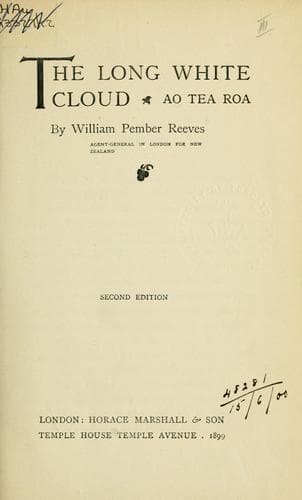
The Long White Cloud: "Ao Tea Roa"Reeves, William Pember
History
The Long White Cloud: "Ao Tea Roa"
Reeves, William Pember
Ethnology -- New Zealand; New Zealand
With one exception, the constitutional changes of the eight years may
be dismissed in a very few words. The Upper Chamber, or Legislative
Council of New Zealand, is nominative and not elective, nor is there
any fixed limit to its numbers. Liable, thus, to be diluted by Liberal
nominees, it is not so strong an obstacle to the popular will as are
the Elective Councils of certain Australian Colonies. Prior to 1891,
however, the nominations in New Zealand were for life. This was
objected to for two reasons. A Councillor, who at the age of sixty
might be a valuable adviser, might twelve years later be but
the shadow of his former self. Moreover, experience showed that
Conservatism was apt to strengthen in the nominated legislator's mind
with advancing years. So a seven years' tenure has been substituted
for life tenure. Then, again, in 1891 the Liberal majority in the
Colony was scarcely represented in the Council at all. In important
divisions, Government measures passed by decisive majorities in the
popular Chamber could only muster two, three, four, or five supporters
in the Council. This not only meant that a hostile majority could
reject and amend as it pleased, but that measures were not even fairly
debated in the Upper House. Only one side was heard. In 1892 the
Ballance Ministry, therefore, asked the Governor to call twelve fresh
Councillors. His Excellency demurred to the number. As there was about
to be a change of Governors the matter stood over. The new Governor
proved as unwilling as his predecessor. Ballance held that in this
matter, as in others, the constitutional course was for the Governor
to take the advice of his Ministers. His Excellency thought otherwise.
By mutual consent the matter was referred to the Colonial Office,
where Lord Ripon decided in favour of the Premier. Twelve new
Councillors were nominated. Though this submission to the arbitration
of the Colonial Office was attacked not only by colonial Conservatives
but by Sir George Grey, it was highly approved of both by the Lower
House and the mass of the electors, and was regarded as one of
Ballance's most important successes.
Public-domain text, read in full here on John Shaqi.
Reviews
Reviews
No reviews yet
Be the first to share your thoughts on this work.
Elsewhere in the archive
Join the Discussion
Join the discussion
Sign in to leave a comment or review.
Sign InorCreate an account