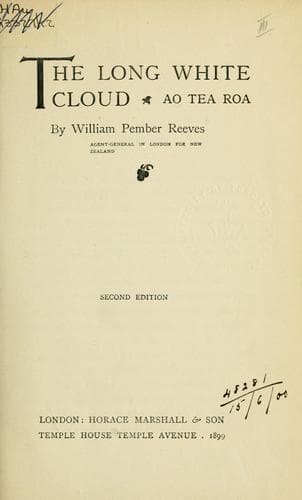
The Long White Cloud: "Ao Tea Roa"Reeves, William Pember
History
The Long White Cloud: "Ao Tea Roa"
Reeves, William Pember
Ethnology -- New Zealand; New Zealand
Another he did not live to see achieved. His Electoral Bill, wrecked
twice in the Council, was only passed some months after his death.
Under it the one-man-one-vote was carried to its complete issue by the
clause providing for one man one registration; that is to say, that
no voter could register on more than one roll. Consequently
property-owners were not only cut down to one vote in one district at
a general election, but were prevented from voting in another district
at a by-election. The right to vote by letter was extended from seamen
to shearers. But much the greatest extension of the franchise was
the giving it to women. This was a curious example of a remarkable
constitutional change carried by a Parliament at the election of
which the question had scarcely been discussed. Labour, Land, and
Progressive Taxation had been so entirely the ascendant questions at
the General Election of 1890, that it came as a surprise to most to
learn next year that the House of Representatives was in favour of
women's suffrage. Even then it was not generally supposed that the
question would be settled. Sir John Hall, however, its consistent
friend, brought it up in the House, and Ballance, an equally earnest
supporter, at once accepted it. After that, the only doubts as to its
becoming law sprang from the attitude of the Legislative Council,
and from the scruples of certain persons who thought that so great a
change should be definitely submitted to the constituencies. Feeling
was both strengthened and exacerbated by the enthusiasm of the
Prohibition lodges, some of whose members at the same time demanded
that the Government should pass the measure, and emphatically
assured every one that its passing would forthwith bring about the
Government's downfall and damnation. There is no doubt that many of
the Ministry's opponents believed this, and that to their mistake was
due the escape of the Bill in the Council. It was passed on the eve of
the General Elections by the narrowest possible majority. The rush
of the women on to the rolls; the interest taken by them in the
elections; the peaceable and orderly character of the contests; and
the Liberal majority returned at two successive General Elections are
all matters of New Zealand history.
Public-domain text, read in full here on John Shaqi.
Reviews
Reviews
No reviews yet
Be the first to share your thoughts on this work.
Elsewhere in the archive
Join the Discussion
Join the discussion
Sign in to leave a comment or review.
Sign InorCreate an account