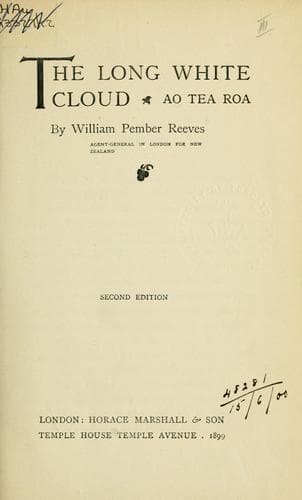
The Long White Cloud: "Ao Tea Roa"Reeves, William Pember
History
The Long White Cloud: "Ao Tea Roa"
Reeves, William Pember
Ethnology -- New Zealand; New Zealand
There are some who connect the appearance of women in the political
arena with the recent passing of an Infants' Life Protection Act, the
raising of the age of consent to fifteen, the admission of women to
the Bar, the appointment of female inspectors to lunatic asylums,
factories, and other institutions, improvements in the laws dealing
with Adoption of Children and Industrial Schools, a severe law against
the keepers of houses of ill-fame, and with the new liquor laws and
the Prohibitionist movement which is so prominent a feature of New
Zealand public life.
A handy volume issued by the Government printer contains most of
the Labour Laws of New Zealand. They are now twenty-six in number,
comprising Acts, amending Acts, and portions of Acts. Their aim is not
the abolition of the wages system, but, as far as may be to make that
system fair and tolerable, and in protecting the labourer to protect
the fair employer. Some twenty of these laws have been passed during
the last seven years. Of these an Employers' Liability Act resembles
Mr. Asquith's ill-fated Bill. Worked in conjunction with a law for
the inspection of machinery and a thorough-going system of factory
inspection, it has lessened accidents without leading to litigation.
It neither permits contracting-out nor allows employers to escape
liability by means of letting out contracts.
A Truck Act declares the right of every wage-earner to be paid
promptly, in full, in the current coin of the realm, and to be allowed
to spend wages as they choose. Two more enactments deal with the
earnings of the workmen of contractors and sub-contractors, make them
a first charge on all contract money, give workers employed on works
of construction a lien thereon, and compel a contractor's employer to
hold back at least one-fourth of the contract money for a month after
the completion of a contract, unless he shall be satisfied that all
workmen concerned have been paid in full. A Wages Attachment Act
limits without entirely abolishing a creditor's right to obtain orders
of court attaching forthcoming earnings.
Public-domain text, read in full here on John Shaqi.
Reviews
Reviews
No reviews yet
Be the first to share your thoughts on this work.
Elsewhere in the archive
Join the Discussion
Join the discussion
Sign in to leave a comment or review.
Sign InorCreate an account