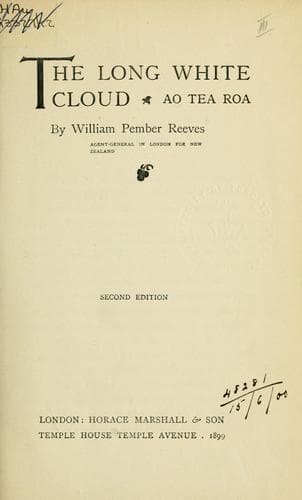
The Long White Cloud: "Ao Tea Roa"Reeves, William Pember
History
The Long White Cloud: "Ao Tea Roa"
Reeves, William Pember
Ethnology -- New Zealand; New Zealand
Most of the women voters show as yet no disposition to follow the
clergy in assailing the national system of free, secular, and
compulsory education. They clearly favour temperance reform, but are
by no means unanimous for total prohibition. On the whole, the most
marked feature of their use of the franchise is their tendency to
agree with their menkind. Families, as a rule, vote together, and the
women of any class or section are swayed by its interests, prejudices,
or ideals to just about the same extent as the males thereof. Thus,
the friends and relatives of merchants and professional men, large
landowners, or employers of labour, usually vote on one side; factory
girls, domestic servants, wives of labourers, miners, artisans, or
small farmers, on the other. Schoolmistresses are as decidedly for
secular education as are schoolmasters. It is too soon to pronounce
yet with anything like confidence on the results of this great
experiment. We have yet to see whether female interest in politics
will intensify or fade. At present, perhaps, the right of every adult
woman to vote is more remarkable for what it has not brought about
than for what it has. It has not broken up existing parties, unsexed
women, or made them quarrel with their husbands, or neglect their
households. It has not interfered with marriage, or society, or the
fashion of dress. The ladies are not clamouring to be admitted to
Parliament. They do less platform-speaking than Englishwomen do,
though many of them study public affairs--about which, to say truth,
they have much to learn. Observers outside the Colony need not suppose
that New Zealand women are in the least degree either "wild," or
"new," or belong to any shrieking sisterhood. Though one or two have
entered learned professions, most of them are engaged in domestic
duties. Those who go out into the world do so to work unassumingly
as school teachers, factory hands, or household servants. As school
teachers they are usually efficient, as domestic servants civil and
hard-working, as factory hands neat, industrious, and moral. It is
true that they are, without exception, educated to the extent of
having had at least good primary school teaching. But though they
read--clean, healthy English books--this, so far from making them
inclined to favour frantic or immoral social experiments, should have,
one may hope, just the opposite effect. Far from being a spectacled,
angular, hysterical, uncomfortable race, perpetually demanding
extravagant changes in shrill tones, they are, at least, as
distinguished for womanly modesty, grace, and affection, as
Englishwomen in any other part of the Empire.
Public-domain text, read in full here on John Shaqi.
Reviews
Reviews
No reviews yet
Be the first to share your thoughts on this work.
Elsewhere in the archive
Join the Discussion
Join the discussion
Sign in to leave a comment or review.
Sign InorCreate an account