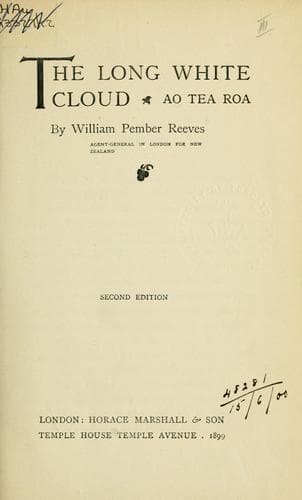
The Long White Cloud: "Ao Tea Roa"Reeves, William Pember
History
The Long White Cloud: "Ao Tea Roa"
Reeves, William Pember
Ethnology -- New Zealand; New Zealand
refused to accept the arbitrators' award, and lost their work. But of
strikes by Trades Unions there have been none, and there should be
none so long as the Act can be made to work.
As to the kind of questions arbitrated upon, they comprise most of the
hard nuts familiar to students of the Labour problem. Among them are
hours of labour, holidays, the amount of day wages, the price to
be paid for piece-work, the proportion of apprentices to skilled
artizans, the facilities to be allowed to Trade Union officials
for interviews with members, the refusal of Unionists to work with
non-Union men, and the pressure exerted by employees to induce workmen
to join private benefit societies. A New Zealand employer, it may be
mentioned, cannot take himself outside the Act of discharging his
Union hands, or even by gradually ceasing to engage Union men, and
then pleading that he has none left in his employ. A Union, whose
members are at variance with certain employers in a trade, may bring
all the local employees engaged in that trade into court, so that the
same award may be binding on the whole trade in the district.
Most of the references have been anything but trivial affairs,
either as to the numbers of workmen concerned, or the value of the
industries, or importance of the points in dispute. It is wrong to
suppose that the operation of the Act is confined to industries
protected by high customs duties, or to workers in factories. It may
be applied wherever workers are members of legally constituted bodies,
set up either under the Trade Union Act, or under the Arbitration
Statute itself. Unions who want to make use of it, register under
it; and some eighty have already done so. Trade Unions who do not
specially register may nevertheless be brought before the Arbitration
Court by the employers of their members. So far the Act has met with
a remarkable measure of success. The Trade Unions are enthusiastic
believers in it,--rather too enthusiastic, indeed, for they have shown
a tendency to make too frequent a use of it. Some of their officials,
too, would do well to be more brief and businesslike in the conduct
of cases. On the other hand, employers in most of the localities have
made a serious mistake in refusing to elect representatives for the
local Conciliation Boards, and thus forcing the Government to nominate
members. This has weakened the Boards, has hindered them from having
the conciliatory character they ought to have, and has led in part
to the frequent appeals to the Central Court of which the employers
themselves complain. The lawyers claim to have discovered that the
penalty clauses of the Act are badly drafted, and some of them assert
that unless these are amended, they will be able to drive a coach
and six through the statute. No doubt technical amendments will
be required from time to time. What is still more requisite is an
understanding between the more reasonable leaders on both sides of
Public-domain text, read in full here on John Shaqi.
Reviews
Reviews
No reviews yet
Be the first to share your thoughts on this work.
Elsewhere in the archive
Join the Discussion
Join the discussion
Sign in to leave a comment or review.
Sign InorCreate an account