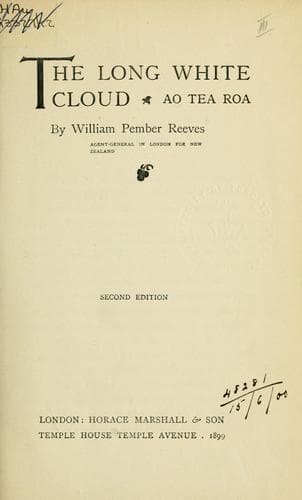
The Long White Cloud: "Ao Tea Roa"Reeves, William Pember
History
The Long White Cloud: "Ao Tea Roa"
Reeves, William Pember
Ethnology -- New Zealand; New Zealand
industry, by which arrangements may be made for the more effectual and
informal use of the Conciliation Boards. Meanwhile it savours of the
absurd to talk and write--as certain fault-finders have done--as
though every arbitration under the Act were a disturbance of industry
as ruinous as a prolonged strike. Other critics have not stickled to
assert that it has mischievously affected the volume of the Colony's
industries, a statement which is simply untrue. It is the reviving
prosperity of the Colony during the last three years which has led the
Trade Unions to make so much use of the Act. In place of striking on
a rising market, as they do in other countries, they have gone to
arbitration. Public opinion in New Zealand has never been one-sided on
the question. It has all along been prepared to give this important
experiment a fair trial, and is quite ready to have incidental
difficulties cured by reasonable amendment.
The Shipping and Seamen's Act, 1894, and the amending Acts of the two
following years, mitigate the old-fashioned severity of punishments
for refusal of duty, assaults on the high seas, and other nautical
offences. The forecastle and the accommodation thereof become subject
to the _fiat_ of the Government inspector, as are factories on shore.
Regular payment of wages is stipulated for, overcrowding amongst
passengers is forbidden. Complete powers are given to the marine
authorities to enforce not only a full equipment of life-boats and
life-saving appliances, but boat-drill. Deck loading is restricted,
and the Plimsoll mark insisted on. But the portion of the Act which
gave rise to the intensest opposition was the proviso by which all
sailing vessels are obliged to carry a certain complement of able
seamen and ordinary seamen, according to their tonnage, while steamers
must carry a given number of able seamen, ordinary seamen, firemen,
trimmers, and greasers, according to their horse-power. Foreign
vessels, while engaging in the New Zealand coasting-trade, have to pay
their crews the rate of wages current on the coast. Parliament was
warned that the passing of this Act would paralyze the trade of
the Colony, but passed it was--with certain not unreasonable
amendments--and trade goes on precisely as before.
In 1891, moreover, the colonial laws relating to mining generally,
and to coal-mining especially, were consolidated and amended. An
interesting feature in the New Zealand Coal Mines' Act is the
provision by which mine-owners have to contribute to a fund for the
relief of miners or the families of miners in cases where men are
injured or killed at work. Every quarter the owners have to pay a
halfpenny per ton on the output, if it be bituminous coal; and a
farthing a ton, if it be lignite. Payment is made into the nearest
Post Office Savings Bank and goes to the credit of an account called
"The Coal Miners' Relief Fund." From 1891 mineral rights are reserved
in lands thereafter alienated by the Crown.
Public-domain text, read in full here on John Shaqi.
Reviews
Reviews
No reviews yet
Be the first to share your thoughts on this work.
Elsewhere in the archive
Join the Discussion
Join the discussion
Sign in to leave a comment or review.
Sign InorCreate an account