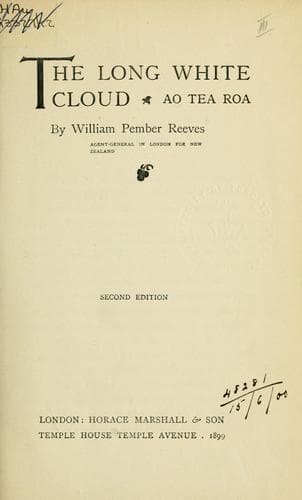
The Long White Cloud: "Ao Tea Roa"Reeves, William Pember
History
The Long White Cloud: "Ao Tea Roa"
Reeves, William Pember
Ethnology -- New Zealand; New Zealand
Their speech is that of communities who are seldom utterly illiterate,
and as seldom scholarly. I have listened in vain for any national
twang, drawl, or peculiar intonation. The young people, perhaps, speak
rather faster than English of the same age, that is all. On the other
hand, anything like picturesque, expressive language within the limits
of grammar is rarely found. Many good words in daily use in rural
England have been dropped in the Colony. Brook, village, moor,
heath, forest, dale, copse, meadow, glade are among them. Young New
Zealanders know what these mean because they find them in books, but
would no more think of employing them in speaking than of using "inn,"
"tavern," or "ale," when they can say "hotel," "public-house," or
"beer." Their place is taken by slang. Yet if a nation is known by its
slang, the New Zealanders must be held disposed to borrow rather
than to originate, for theirs is almost wholly a mixture of English,
American, and Australian. Most of the mining terms come from
California; most of the pastoral from Australia, though "flat" and
"creek" are, of course, American. "Ranche" and "gulch" have not
crossed the Pacific; their place is taken by "run" and "gulley." On
the other hand, "lagoon" has replaced the English "pond," except in
the case of artificial water. Pasture is "feed," herd and flock alike
become "mob." "Country" is used as a synonym for grazing; "good
country" means simply good grazing land. A man tramping in search of
work is a "swagman" or "swagger," from the "swag" or roll of blankets
he carries on his back. Very few words have been adopted from the
vigorous and expressive Maori. The convenient "mana," which covers
prestige, authority, and personal magnetism; "wharé," a rough hut;
"taihoa," equivalent to the Mexican _manana_; and "ka pai," "'tis
good," are exceptions. The South Island colonists mispronounce their
beautiful Maori place-names murderously. Even in the North Island the
average bushman will speak of the pukatea tree as "bucketeer," and
not to call the poro-poro shrub "bull-a-bull" would be considered
affectation. There is or was in the archives of the Taranaki Farmers'
Club a patriotic song which rises to the notable lines--
"And as for food, the land is full
Of that delicious bull-a-bull!"
In Canterbury you would be stared at if you called Timaru anything but
"Timmeroo." In Otago Lake Wakatipu becomes anything, from "Wokkertip"
to "Wackatipoo"; and I have heard a cultured man speak of Puke-tapu as
"Buck-a-tap."
Public-domain text, read in full here on John Shaqi.
Reviews
Reviews
No reviews yet
Be the first to share your thoughts on this work.
Elsewhere in the archive
Join the Discussion
Join the discussion
Sign in to leave a comment or review.
Sign InorCreate an account