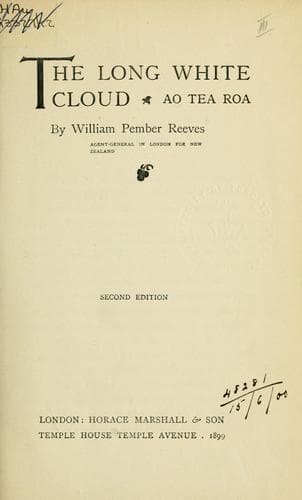
The Long White Cloud: "Ao Tea Roa"Reeves, William Pember
History
The Long White Cloud: "Ao Tea Roa"
Reeves, William Pember
Ethnology -- New Zealand; New Zealand
The intellectual average is good. Thanks in great part to Gibbon
Wakefield's much-abused Company, New Zealand was fortunate in the
mental calibre of her pioneer settlers, and in their determined
efforts to save their children from degenerating into loutish,
half-educated provincials. Looking around in the Colony at the sons
of these pioneers, one finds them on all sides doing useful and
honourable work. They make upright civil servants, conscientious
clergymen, schoolmasters, lawyers, and journalists, pushing agents,
resourceful engineers, steady-going and often prosperous farmers,
and strong, quick, intelligent labourers. Of the "self-reverence,
self-knowledge, self-control" needful to make a sound race they have
an encouraging share. Of artistic, poetic, or scientific talent, of
wit, originality, or inventiveness, there is yet but little sign. In
writing they show facility often, distinction never; in speech fluency
and force of argument, and even, sometimes, lucidity, but not a flash
of the loftier eloquence. Nor has the time yet arrived for Young New
Zealand to secure the chief prizes of its own community--such posts
and distinctions as go commonly to men fairly advanced in years. No
native of the country has yet been its Prime Minister or sat amongst
its supreme court judges or bishops. A few colonial-born have held
subordinate Cabinet positions, but the dozen leading Members of
Parliament are just now all British-born. So are the leading doctors,
engineers, university professors, and preachers; the leading barrister
is a Shetlander. Two or three, and two or three only, of the
first-class positions in the civil service are filled by natives. On
the whole, Young New Zealand is, as yet, better known by collective
usefulness than by individual distinction.
The grazing of sheep and cattle, dairying, agriculture, and mining for
coal and gold, are the chief occupations. 47,000 holdings are under
cultivation. The manufactures grow steadily, and already employ 40,000
hands. A few figures will give some notion of the industrial and
commercial position. The number of the sheep is a little under
20,000,000; of cattle, 1,150,000; of horses, 250,000. The output of
the factories and workshops is between £10,000,000 and £11,000,000
sterling a year; the output of gold, about £1,000,000; that of coal,
about 900,000 tons. The export of wool is valued at £4,250,000. Among
the exports for 1897 were: 2,700,000 frozen sheep and lambs; 66,000
cwt. cheese, and 71,000 cwt butter; £433,000 worth of kauri gum;
£427,000 worth of grain. The exports and imports of the Colony for
the year 1897 were a little over £10,000,000 and £8,000,000 sterling
respectively. It would appear that, taking a series of years, about
three-quarters of the Colony's trade has been with the mother-country,
and nearly all the remainder with other parts of the Empire. The
public debt is about £44,000,000; the revenue, £5,000,000. The State
owns 2,061 miles of railway.
Public-domain text, read in full here on John Shaqi.
Reviews
Reviews
No reviews yet
Be the first to share your thoughts on this work.
Elsewhere in the archive
Join the Discussion
Join the discussion
Sign in to leave a comment or review.
Sign InorCreate an account