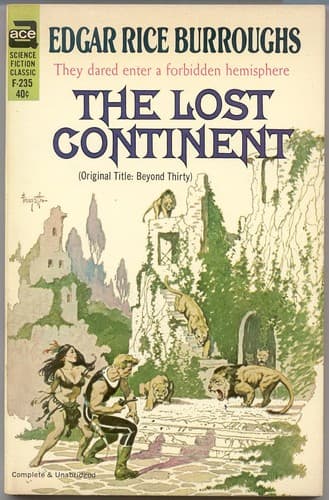
England -- Fiction; Fantasy fiction; Science fiction
He never heard the word ship before, and did not know its meaning. But
he assured me that until we came he had thought that there were no
other peoples in the world other than the Grubittens, who consist of
the Eastenders and the Westenders of the ancient Isle of Wight.
Assured that we were inclined to friendliness, our new acquaintances
led us to their village, or, as they call it, camp. There we found a
thousand people, perhaps, dwelling in rude shelters, and living upon
the fruits of the chase and such sea food as is obtainable close to
shore, for they had no boats, nor any knowledge of such things.
Their weapons were most primitive, consisting of rude spears tipped
with pieces of metal pounded roughly into shape. They had no
literature, no religion, and recognized no law other than the law of
might. They produced fire by striking a bit of flint and steel
together, but for the most part they ate their food raw. Marriage is
unknown among them, and while they have the word, mother, they did not
know what I meant by “father.” The males fight for the favor of the
females. They practice infanticide, and kill the aged and physically
unfit.
The family consists of the mother and the children, the men dwelling
sometimes in one hut and sometimes in another. Owing to their bloody
duels, they are always numerically inferior to the women, so there is
shelter for them all.
We spent several hours in the village, where we were objects of the
greatest curiosity. The inhabitants examined our clothing and all our
belongings, and asked innumerable questions concerning the strange
country from which we had come and the manner of our coming.
I questioned many of them concerning past historical events, but they
knew nothing beyond the narrow limits of their island and the savage,
primitive life they led there. London they had never heard of, and they
assured me that I would find no human beings upon the mainland.
Much saddened by what I had seen, I took my departure from them, and
the three of us made our way back to the launch, accompanied by about
five hundred men, women, girls, and boys.
As we sailed away, after procuring the necessary ingredients of our
chemical fuel, the Grubittens lined the shore in silent wonder at the
strange sight of our dainty craft dancing over the sparkling waters,
and watched us until we were lost to their sight.
CHAPTER IV.
It was during the morning of July 6, 2137, that we entered the mouth of
the Thames—to the best of my knowledge the first Western keel to cut
those historic waters for two hundred and twenty-one years!
But where were the tugs and the lighters and the barges, the lightships
and the buoys, and all those countless attributes which went to make up
the myriad life of the ancient Thames?
Gone! All gone! Only silence and desolation reigned where once the
commerce of the world had centered.
Public-domain text, read in full here on John Shaqi.
Reviews
Reviews
No reviews yet
Be the first to share your thoughts on this work.
Join the Discussion
Join the discussion
Sign in to leave a comment or review.
Sign InorCreate an account