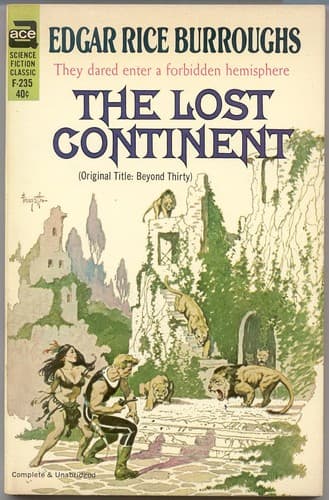
England -- Fiction; Fantasy fiction; Science fiction
Buckingham. The name was famous in ancient English history. Its
survival, with many other illustrious names, is one of the strongest
arguments in refutal of Professor Cortoranl’s theory; yet it opens no
new doors to the past, and, on the whole, rather adds to than
dissipates the mystery.
“And who is Buckingham,” I asked, “and why should he wish to kill me?”
“He would think that you had stolen me,” she replied, “and as he wishes
me for himself, he will kill any other whom he thinks desires me. He
killed Wettin a few days ago. My mother told me once that Wettin was my
father. He was king. Now Buckingham is king.”
Here, evidently, were a people slightly superior to those of the Isle
of Wight. These must have at least the rudiments of civilized
government since they recognized one among them as ruler, with the
title, king. Also, they retained the word father. The girl’s
pronunciation, while far from identical with ours, was much closer than
the tortured dialect of the Eastenders of the Isle of Wight. The longer
I talked with her the more hopeful I became of finding here, among her
people, some records, or traditions, which might assist in clearing up
the historic enigma of the past two centuries. I asked her if we were
far from the city of London, but she did not know what I meant. When I
tried to explain, describing mighty buildings of stone and brick, broad
avenues, parks, palaces, and countless people, she but shook her head
sadly.
“There is no such place near by,” she said. “Only the Camp of the Lions
has places of stone where the beasts lair, but there are no people in
the Camp of the Lions. Who would dare go there!” And she shuddered.
“The Camp of the Lions,” I repeated. “And where is that, and what?”
“It is there,” she said, pointing up the river toward the west. “I have
seen it from a great distance, but I have never been there. We are much
afraid of the lions, for this is their country, and they are angry that
man has come to live here.
“Far away there,” and she pointed toward the south-west, “is the land
of tigers, which is even worse than this, the land of the lions, for
the tigers are more numerous than the lions and hungrier for human
flesh. There were tigers here long ago, but both the lions and the men
set upon them and drove them off.”
“Where did these savage beasts come from?” I asked.
“Oh,” she replied, “they have been here always. It is their country.”
“Do they not kill and eat your people?” I asked.
“Often, when we meet them by accident, and we are too few to slay them,
or when one goes too close to their camp. But seldom do they hunt us,
for they find what food they need among the deer and wild cattle, and,
too, we make them gifts, for are we not intruders in their country?
Really we live upon good terms with them, though I should not care to
meet one were there not many spears in my party.”
“I should like to visit this Camp of the Lions,” I said.
Public-domain text, read in full here on John Shaqi.
Reviews
Reviews
No reviews yet
Be the first to share your thoughts on this work.
Join the Discussion
Join the discussion
Sign in to leave a comment or review.
Sign InorCreate an account