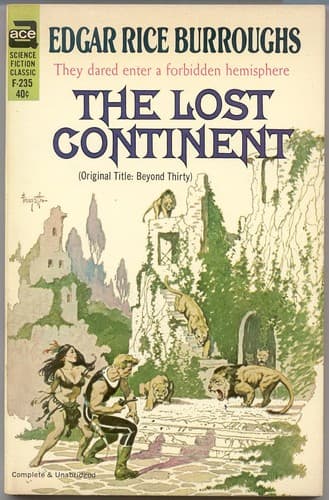
England -- Fiction; Fantasy fiction; Science fiction
“It is too bad that you did not do as I bid you,” she said, “for now it
has happened just as I feared—Buckingham has you.”
“Which is Buckingham?” I asked.
“I am Buckingham,” growled a burly, unwashed brute, swaggering
truculently before me. “And who are you who would have stolen my
woman?”
The girl spoke up then and tried to explain that I had not stolen her;
but on the contrary I had saved her from the men from the “Elephant
Country” who were carrying her away.
Buckingham only sneered at her explanation, and a moment later gave the
command that started us all off toward the west. We marched for a
matter of an hour or so, coming at last to a collection of rude huts,
fashioned from branches of trees covered with skins and grasses and
sometimes plastered with mud. All about the camp they had erected a
wall of saplings pointed at the tops and fire hardened.
This palisade was a protection against both man and beasts, and within
it dwelt upward of two thousand persons, the shelters being built very
close together, and sometimes partially underground, like deep
trenches, with the poles and hides above merely as protection from the
sun and rain.
The older part of the camp consisted almost wholly of trenches, as
though this had been the original form of dwellings which was slowly
giving way to the drier and airier surface domiciles. In these trench
habitations I saw a survival of the military trenches which formed so
famous a part of the operation of the warring nations during the
twentieth century.
The women wore a single light deerskin about their hips, for it was
summer, and quite warm. The men, too, were clothed in a single garment,
usually the pelt of some beast of prey. The hair of both men and women
was confined by a rawhide thong passing about the forehead and tied
behind. In this leathern band were stuck feathers, flowers, or the
tails of small mammals. All wore necklaces of the teeth or claws of
wild beasts, and there were numerous metal wristlets and anklets among
them.
They wore, in fact, every indication of a most primitive people—a race
which had not yet risen to the heights of agriculture or even the
possession of domestic animals. They were hunters—the lowest plane in
the evolution of the human race of which science takes cognizance.
And yet as I looked at their well shaped heads, their handsome
features, and their intelligent eyes, it was difficult to believe that
I was not among my own. It was only when I took into consideration
their mode of living, their scant apparel, the lack of every least
luxury among them, that I was forced to admit that they were, in truth,
but ignorant savages.
Buckingham had relieved me of my weapons, though he had not the
slightest idea of their purpose or uses, and when we reached the camp
he exhibited both me and my arms with every indication of pride in this
great capture.
Public-domain text, read in full here on John Shaqi.
Reviews
Reviews
No reviews yet
Be the first to share your thoughts on this work.
Join the Discussion
Join the discussion
Sign in to leave a comment or review.
Sign InorCreate an account