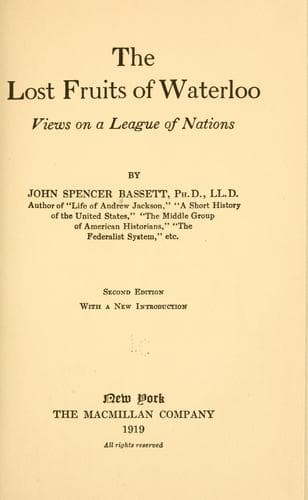
International cooperation; Peace; World War, 1914-1918
Another obstacle to enduring peace is a false sense of patriotism. If
a man extols his own virtues we say he is a boaster: if he extols the
good qualities of his town, state, or nation, we say he is a patriot.
I am inclined to say that it is not permitted to a man to praise his
country--I do not say love his country--in any sense but that in which
he may praise himself, modestly and with reservations. At any rate, he
should praise and magnify his country in the most restrained spirit
possible. Patriotism does not demand national egotism in the good
citizen. Those writers and teachers who try to create a national spirit
should be careful lest they make men mere chauvinists.
Especially perilous is the doctrine that “self-preservation is the
first law of nature” as applied to nations. Times come when a man
is not justified in preserving his life. So to nations come crises
in which they are not permitted by the rules of morality to save
themselves by what appear to be the only means left. In the present war
Germany asserted that she was justified by this principle in adopting
the ruthless war of the submarine, since it was the only thing that
would save her from destruction. It is better for a state to go to
destruction, just as it is better for a man to go to his death, with
clean hands than to live foully.
It is but an extension of this doctrine for men of normal morality to
say they may do things for the benefit of the state which they may not
do for their own benefit. A statesman has no more right to make his
state steal another state’s lands than he has to take his neighbor’s
watch. It is not a virtue if he lies for his state. The state cannot
speak of itself: it speaks through its agents. It is sullied, even as
a man is sullied in his character, when its only voice, the words and
acts of its servants, is not true. Judged by the standards here set
up, the world’s diplomacy needs amendment, and if amended one of the
obstacles to peace will be removed.
A false sense of patriotism may lead to acts that imperil peace.
When France acquired Morocco her object was not wholly to extend
her economic interests. To increase the national strength was also
a motive. Likewise, Germany’s desire to establish control over the
territory southeast of her was not entirely economic in its origin. She
also wished to increase the glory and strength of the Fatherland. How
much we are to condemn this desire of a citizen for the glory of his
country it is hard to say; but it seems to be clear that such a desire
may manifest itself in such a way as to become a serious obstacle to
peace.
Public-domain text, read in full here on John Shaqi.
Reviews
Reviews
No reviews yet
Be the first to share your thoughts on this work.
Elsewhere in the archive
Join the Discussion
Join the discussion
Sign in to leave a comment or review.
Sign InorCreate an account