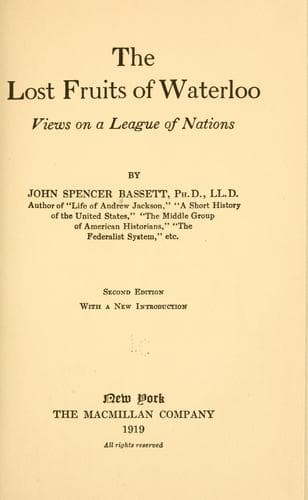
International cooperation; Peace; World War, 1914-1918
At the end of the present war the victorious nations will be in a
position to abate national glory in the interest of enduring peace.
Our own citizens are supposed to be particularly proud of the
achievements of the United States. If our efforts should contribute as
much as we wish to the triumph of our own side, we should be careful
lest we forget that we entered the war with the modest purpose of
making the world a fit place of habitation for _all_ people. Likewise
we should be justified in using our influence among our allies to see
that the desire of no statesman to enhance the glory of his nation
leads to action which may imperil peace in the future. When we shall
have fought long and suffered greatly our hearts are likely to become
harder than now, in the beginning of the war; and there is danger that
we shall forget early resolutions if we are not firmly committed to
them at the outset.
Another obstacle to enduring peace is the sense of nationality. The
older men of this generation who were students in Germany in their
youth acquired much respect for the passionate desire of Germans to
build up unity among all German speaking people. It was a sacred
idea to young men and imaginative writers. Long had North Germany
been disunited, stumbling forward under the lead of the Hapsburgs.
To be able to form a dominating group among all the Germans in the
world seemed no more than was their just due. We did not realize in
those days to what an end these people who lost so many opportunities
through internal weakness would put their strength when they had at
last developed it. And yet, it was the right of the Germans to unite
themselves into as strong a nation as they might form. The wrong came
in the improper extension of the idea. When men like Treitschke talk
about including Holland in the German Fatherland we may well ask where
nationality’s pretensions are taking us?
It was natural, also, that the sense of nationality should be
manifested in many other European countries. Each of the Balkan states
had its own phase of it. Russia had a large hope of uniting in her
control all the peoples of Slavic blood. Italy demanded Trieste as a
part of the Italian-speaking world. Greece lived for the acquisition
of Macedonia and the Greek Islands, and France never diminished her
pathetic longing for Alsace-Lorraine, where lived French-speaking
peoples.
Public-domain text, read in full here on John Shaqi.
Reviews
Reviews
No reviews yet
Be the first to share your thoughts on this work.
Elsewhere in the archive
Join the Discussion
Join the discussion
Sign in to leave a comment or review.
Sign InorCreate an account