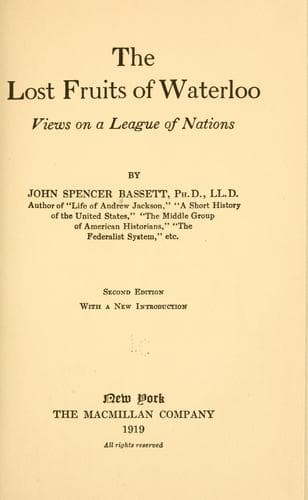
International cooperation; Peace; World War, 1914-1918
These men are not mere pieces of machinery in a great driving process.
They are thinking men with political power in their hands, either
actually or potentially. War is a great schoolteacher. It has lasted
in our own time nearly as long as a course in college. The soldiers
who survive from the beginning of this conflict may now be considered
as more than half through their senior year. They know what war is
and what it means, and they know something about the necessary form
of coöperation that must exist in any society before the will of the
people can be carried into effect. They knew little about war four
years ago: they now know all the professors know. Behind the lines and
here in our homes one never sees man nor woman who does not admit that
it would be a blessing to make war impossible; but few of us have any
idea how to go about getting it made impossible. Many of us think we
shall never get people to act together in such a cause. But it seems
unreasonable to expect that men who have raided through “No Man’s
Land,” captured trenches and defeated great armies through organization
and initiative should quail before the inertia of opinion, perhaps the
chief obstacle confronting those who labor for a coöperative peace.
The example of the Russians is a useful point in this connection. At
the beginning of the war their armies were as machine-like as any
armies could be. The privates were generally peasants who did not know
why they fought, and who certainly had nothing to say about the origin
of the war. They were typical “cannon-fodder,” and as unthinking as
any modern soldier can be. They have learned much from less than three
years of war. They slowly acquired purpose, a sense of organization,
and leaders whom they follow. Having made this progress they overthrew
the imperial government, drove away the great nobles, put an ensign in
the place of a former grand duke and two exiles in the seats of the
highest officials, and stripped the highest born army officers of their
titles and insignia.
At the present writing they are holding out against all attempts to
overthrow them, they are playing the diplomatic game with Germany
without discredit,[1] and they are reported to be shaking the
foundations of autocracy in Austria. At any rate, it must be confessed
that a small group of the Russian “cannon-fodder” have made commendable
progress in the process of education during the last ten months. The
process seems to have been under the direction of the socialists, a
small but well organized group of intelligent persons who do not lack
initiative. It is they who are educating the Russian peasants into
political self-expression.
[1] Since the above was written events have occurred in
Russia which seem to discredit the diplomacy of the
revolutionists; but the general situation is so unsettled
that no conclusions can be drawn at this time, February 27,
1918.
Public-domain text, read in full here on John Shaqi.
Reviews
Reviews
No reviews yet
Be the first to share your thoughts on this work.
Join the Discussion
Join the discussion
Sign in to leave a comment or review.
Sign InorCreate an account