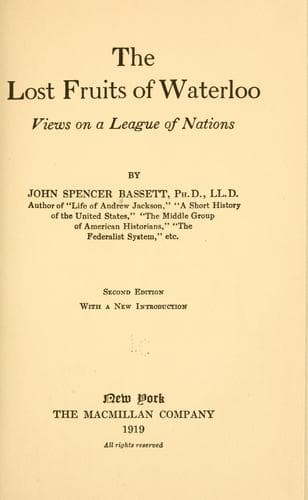
International cooperation; Peace; World War, 1914-1918
Most notable influence of all in behalf of a federated peace is the
position taken by President Wilson. In the beginning of this conflict
he had the scholar’s horror of warfare, and he has taken more than one
opportunity to suggest the formation of a league of nations to prevent
the outbreak of future wars. His address to Congress on January 22,
1917, was a notable presentation of the idea to the world. Enthusiastic
hearers pronounced the occasion a turning-point in history. Whether a
league of nations is established or not, according to the president’s
desires, his support of the idea has given it a great push forward.
He has taken it out of the realm of the ideal and made it a practical
thing, to be discussed gravely in the cabinets of rulers.
A year after the question has been brought forward, it should be
possible to form an opinion of the attitude of European nations in
regard to the suggestion. From all of them, including Germany and
Austria, have come courteous allusions to the idea of the president;
and the pope has given it his support. But it is not clear that all
are sincerely in favor of a logically constituted league that will
have power to do what it is expected to do. That President Wilson will
continue to urge steps in this direction is to be taken as certain. The
measure of his success will be the amount of hearty and substantial
support he has from that large class of people who still ask: “Can’t
something be done to stop war forever?”
When this page is being written the newspapers are full of a discussion
of the two speeches that came from the central powers on January 25,
1918, one from Chancellor von Hertling of Germany, and the other from
Count Czernin, of Austria. In the former is the following utterance:
“I am sympathetically disposed, as my political activity shows,
toward every idea which eliminates for the future a possibility or
a probability of war, and will promote a peaceful and harmonious
collaboration of nations. If the idea of a bond of nations, as
suggested by President Wilson, proves on closer examination really
to be conceived in a spirit of complete justice and complete
impartiality toward all, then the imperial government is gladly
ready, when all other pending questions have been settled, to begin
the examination of the basis of such a bond of nations.”
Public-domain text, read in full here on John Shaqi.
Reviews
Reviews
No reviews yet
Be the first to share your thoughts on this work.
Join the Discussion
Join the discussion
Sign in to leave a comment or review.
Sign InorCreate an account