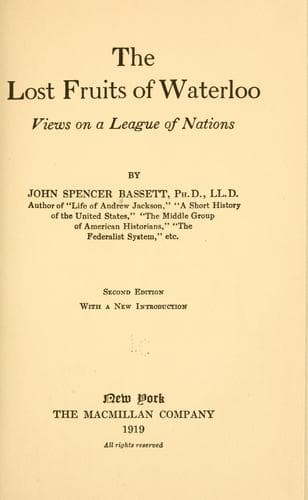
International cooperation; Peace; World War, 1914-1918
In drawing the parallels between the formation of our union and the
possible creation of a federation of nations, it is hard to avoid the
inference that the two systems lead to the same end, federated general
government. And yet they are not the same. Our union was created to
take over a large area of government which the individual states could
not conduct successfully. It has a direct bearing on the citizens of
the states, it even has its own citizenship, although it was a long
time after 1787 before it was defined. It has popular elections, a
postal system, and hundreds of other things which no one would allot
to the kind of federation discussed here. It has been cited only for
the argument that can legitimately be derived from analogous conditions
relating to the difficulties of forming the union.
A world federation, on the other hand, could have only one main
purpose, the preservation of peace. No other bonds should knit it
together except those which exist for that purpose. They would be
strong enough for the strain that would be put upon them, and no
stronger. They would be made for a specific object by persons who would
be careful that they were properly made. A federation of this kind
could not be adopted until it was approved by the authorities in the
constituent nations, which would guarantee that it did not sacrifice
the individuality of those nations. In fact, so great would be the
obstacles at this point that it is safe to say that there would be more
danger that the federation would be too weak rather than that it would
be too strong.
* * * * *
Here ends this statement of the arguments for the only possible plan
of coöperation that will, if adopted, give the world enduring peace.
It would be easier to form a league to enforce peace by arbitration
and moral suasion than to form a federation with power sufficient
to enforce its decrees. But a league would in all probability be
flouted by the states as often as their interests seemed to them to
make it advisable. Reverting to the analogy of our own formative
period in national government, a league would be like our articles of
confederation, weak and insufficient because they did not authorize the
central government to coërce a recalcitrant state. As a step toward a
more desirable end the articles of federation were worth while: as a
similar step a league of nations might be better than nothing, but it
would not lead to the end to which the world is looking.
Public-domain text, read in full here on John Shaqi.
Reviews
Reviews
No reviews yet
Be the first to share your thoughts on this work.
Elsewhere in the archive
Join the Discussion
Join the discussion
Sign in to leave a comment or review.
Sign InorCreate an account