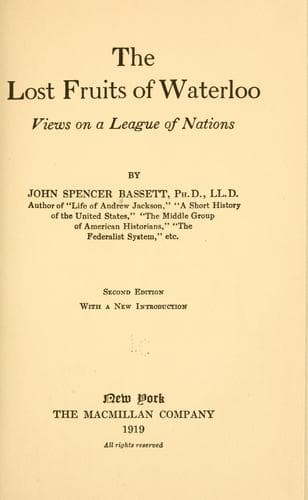
International cooperation; Peace; World War, 1914-1918
The idea of a federation of nations has been behind many a
philosopher’s dream. Jesus looked forward to it when he offered the
world “my peace,” and many another has held that somewhere in the
shadowy future a millennial era of super-government and peace will fall
upon the earth. It would be a great thing if at this day we could take
a step toward the realization of an ideal whose universality attests
its desirability. The “fruits of Waterloo” were lost a century ago by
a wide margin, due to the less perfect comprehension the world then had
of the advantages of federated peace. If they are lost at the end of
this war it will be by a smaller discrepancy. Some time they will be
secured, not because men have dreamed of them; but because, in such a
case at least, dreams are but “suppressed desires.”
The writer of a book can do no more than raise his voice to the people
who do things. To that large class who make things happen he can only
give impulse and hope. His cry goes to those who govern, to those who
direct the press, and to all citizens who feel responsibility for the
formation of good public opinion. If he speaks to them faithfully and
without prejudice or mere enthusiasm, he has done all he can do. The
results are on the knees of the gods.
INDEX
Adams, John Quincy, and the Monroe Doctrine, 79.
Agadir, 171.
Aix-la-Chapelle, Conference of, 66.
Albania, in the Balkan war of 1912-1913, 89, 125, 126;
origin of, 106, 108, 121.
Alexander I, of Russia, 155;
his peace plans, 36, 45-63;
his personal qualities, 46;
his education, 46-48;
and the Treaty of Tilsit, 49;
eyes opened to Napoleon, 50;
his friendship for France, 51;
“grouped” by Castlereagh, 52;
signs treaty of Chaumont, 52;
enters Paris in 1814, 54;
at Congress of Vienna, 55;
and Poland, 56;
and the Holy Alliance, 59-64;
and Baroness Krüdener, 60;
and the Conference of Aix-la-Chapelle, 66;
at Conference at Troppau, 68-70;
his change of policy, 70;
and the Greek war of independence, 77;
and a federation of nations, 263.
Algeciras, Conference at, 168
Alliance, the Treaty of, 65;
the Quadruple, 65, 66, 67;
the Quintuple, 66, 67, 68, 69, 79;
disruption of, 69.
See Holy Alliance.
Alsace and Lorraine, 92.
American Peace Society, 37.
Armageddon, 1-5, 15.
Austria and the Greek war of independence, 77;
and the revolution of 1848, 86;
and Congress of Berlin, 89, 113, 114;
and Balkan War of 1912-1913, 89;
and the Triple Alliance, 93;
acquires rights in Bosnia and Herzegovina, 115;
and the revolt in Crete, 119;
takes over Bosnia and Herzegovina, 120;
interest in the Balkan War of 1912-1913, 124-126, 128.
See Metternich.
Austria-Hungary, see Austria.
Autocracy, an obstacle to permanent peace, 216-224;
qualities of, 217;
in Germany, 219, 220-222;
in Russia, 219;
future bearing of German finances on, 242-246.
Public-domain text, read in full here on John Shaqi.
Reviews
Reviews
No reviews yet
Be the first to share your thoughts on this work.
Elsewhere in the archive
Join the Discussion
Join the discussion
Sign in to leave a comment or review.
Sign InorCreate an account