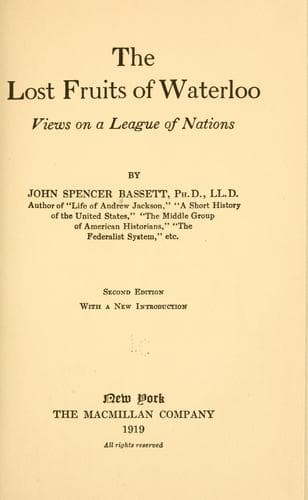
International cooperation; Peace; World War, 1914-1918
There is evidence that in each of these struggles the humane men then
living were filled with the same longing for permanent peace that
many men feel today.[2] The feeling was especially strong during
the last stages of the Napoleonic wars and immediately after they
ended. Singularly enough it was strongest in Russia, due, however
to the accident that an enthusiastic and idealistic tsar was ruling
in that country. He had received his ideals from a French tutor who
was deeply imbued with the equality theories of the revolution that
swept over his own country. The tsar accepted them with sincerity and
spent several years of conscientious effort in his attempts to have
them adopted. More singularly still, they found their only sincere
indorsement, among the rulers who had the right to indorse or reject,
with the king of Prussia, who at that time was a very religious man.
Most peculiar of all they found very strong opposition in England,
where practical statesmen were in power. As I read the history of that
day and reflect on what has been the train of events from the battle of
Waterloo to the invasion of Belgium in 1914, it is hard to keep from
wishing that a better effort had been made in 1815 to carry out the
suggestion which the tsar urged on his royal brothers in Europe.
[2] See below, pp. 46-62.
The defeat of Napoleon was purchased at immense sacrifices. To the
people of the day the most desirable thing in the world seemed to be
a prevention of his reappearance to trouble mankind. They took the
greatest care to keep his body a prisoner until he was dead; but they
did not seriously try to lay his ghost. Probably they did not think,
being practical men, that his spirit would walk again in the earth.
They were mistaken; for not only has the ghost come back, but it has
come with increased power and subtlety. In fact, it was an old ghost,
and having once inhabited the bodies of Louis XIV, Augustus Cæsar, and
Alexander of Macedon, as well as that of Napoleon I, it knew much more
than the grave gentlemen who undertook to arrange the future of Europe
in practical ways in 1815.
As we approach again the re-making of our relations after a world war,
it is worth while to glance over the things that were done in 1815,
to understand what choice of events was presented to the men of that
day, and what results came from the course they deliberately decided to
follow. Thus we may know whether or not the course proved a happy one,
and whether or not it is the course that we, also, should follow. And
if it is not such a course, we ought as thinking people to try to adopt
a better.
Public-domain text, read in full here on John Shaqi.
Reviews
Reviews
No reviews yet
Be the first to share your thoughts on this work.
Join the Discussion
Join the discussion
Sign in to leave a comment or review.
Sign InorCreate an account