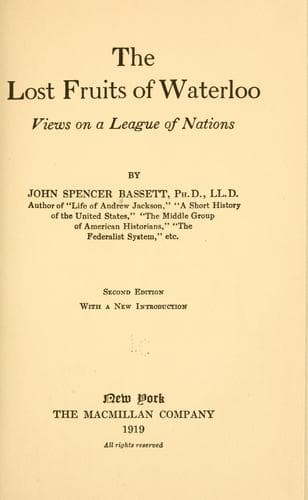
International cooperation; Peace; World War, 1914-1918
As I write, many things indicate that the great conflict is approaching
dissolution. The exhaustion of the nations, the awakening voices of
the masses, the evident failure of militarism to lead Germany to world
empire, the rising spectre of the international solidarity of the
laborers, and many other portents seem to show that the world will soon
have to say “yes” or “no” to the plain question: “Shall we, or shall we
not, have a union of nations to promote permanent peace?”
The warning that they must answer the question is shouted to many
classes. Bankers are threatened with the repudiation of the securities
of the greatest nations, manufacturers may soon see their vast gains
swallowed up in the destruction of the forms of credit which hitherto
have seemed most substantial, churches and every form of intellectual
life that should promote civilization may have their dearest ideals
swept away in a rush toward radicalism, and even the German autocracy
is fighting for its life against an infuriated and despairing
proletariat. Are not these dangers enough to make us ask if the old
menace shall continue?
It is not my purpose to answer all the questions I ask. It is
sufficient to unfold the situation and show how it has arisen out of
the past. If the reader finds that mistakes were once made, he will
have to consider the means of correcting them. No pleader can compel
the opinions of intelligent men and women. It is enough if he lays
the case before clear and conscientious minds in an impersonal way.
More than this he should not try to do: as much as this I have sought
to do. If the world really lost the fruits of its victory over a world
conqueror at Waterloo, it is for the citizen of today to say in what
way the lost fruits can be recovered.
Many friends have aided me in my efforts to present my views to the
public, and among them Dr. Frederick P. Keppel, Dean of Columbia
University, deserves special acknowledgment. I am also under
obligation to Dean Ada C. Comstock, of Smith College, for very careful
proofreading. But for the opinions here expressed and the errors which
may be discovered I alone am responsible.
JOHN SPENCER BASSETT.
Northampton, Massachusetts,
February 5, 1918.
INTRODUCTION
Public-domain text, read in full here on John Shaqi.
Reviews
Reviews
No reviews yet
Be the first to share your thoughts on this work.
Join the Discussion
Join the discussion
Sign in to leave a comment or review.
Sign InorCreate an account