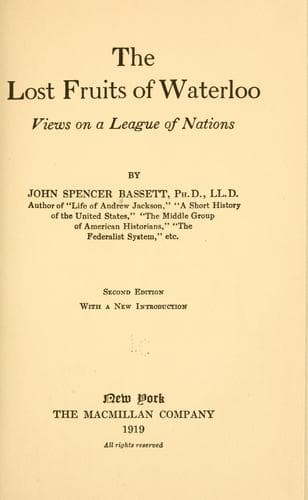
International cooperation; Peace; World War, 1914-1918
Penn’s proposal was that the sovereigns of Europe should form a Great
Diet in which all their disputes should be adjusted. If any state
refused to submit to the judgment of the diet and appealed to arms,
all the other states were to fall upon it with their armies and make
it rue the course it had taken. Quaker though he was, he would have
war to prevent war. His proposal made no impression on his “practical”
contemporaries; but he was prepared for that. Men of his faith were
used to “bearing testimony” in the expectation that “the world” would
scoff. Although it was not included in the original folio edition of
his works this essay remains to this day the best known thing he wrote.
It is one of the most logical arguments for peace that we have.
From 1701 to 1714 was waged the War of the Spanish Succession, the last
of the series of struggles in which Louis XIV wore out his kingdom in
trying to make it supreme over its neighbors. It left France exhausted
and miserable, and it had not realized the king’s ambition. In 1713,
the year in which Louis was forced to accept the Treaty of Utrecht in
token of his defeat, was published by the Abbé Castel de St. Pierre
a book called _Projet de Traité pour rendre la Paix Perpetuelle_.
Like the utterances of Sully and Penn, it was wrung out of the mind
of the author by the ruin that lay around him. It differed from them
in nothing but in its more abundant details. The abbé had taken many
things into account, and the union of nations that he proposed was to
do six important things.
1. There was to be a perpetual alliance of European rulers with a diet
composed of plenipotentiary agents in which disputed points were to
be settled amicably. 2. What sovereigns were to be admitted to the
alliance was to be determined by the act of alliance, which was also to
fix the proportion in which each should contribute to the common fund.
3. The union was to guarantee the sovereignty of the constituent states
with existing boundaries, and future disputes of this nature were to
be referred to the arbitration of the council. 4. States offending
against the laws of the diet were to be put under the ban of Europe.
5. A state under the ban was to be coërced by the other states until
it accepted the laws it had violated. 6. The council was to make such
laws, on instruction from the sovereigns, as were thought necessary to
the objects for which the perpetual alliance was created.
Public-domain text, read in full here on John Shaqi.
Reviews
Reviews
No reviews yet
Be the first to share your thoughts on this work.
Join the Discussion
Join the discussion
Sign in to leave a comment or review.
Sign InorCreate an account