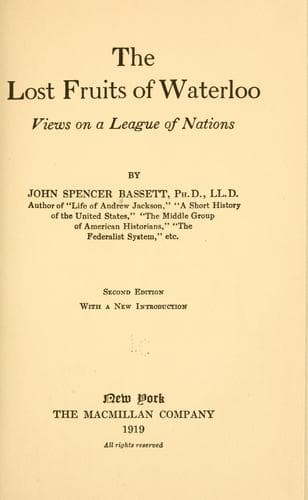
International cooperation; Peace; World War, 1914-1918
Russia and Great Britain were thus in close alliance, and immediately
began consideration of a permanent alliance looking toward a
regulation of affairs in Europe after the war was ended. The British
cabinet took up the question and in 1813 passed a resolution in which
occurs the following declaration: “The Treaty of Alliance [between the
states which were united against Napoleon] is not to terminate with the
war, but is to contain defensive engagements, with mutual obligations
to support the Power attacked by France with a certain extent of
stipulated succors. The _casus foederis_ is to be an attack by France
on the European dominions of any one of the contracting parties.”[4]
This provision was kept secret for the time, but it remained the basis
of the British policy throughout the negotiations that followed.
Castlereagh, in ability and character the greatest statesman of his
day, was then at the head of the British cabinet, and it seems certain
that he inspired its policy.
[4] Phillips, _loc. cit._, 67.
He was already suspicious of the position of the tsar in reference
to France. That sovereign had in no way relaxed his friendship for
the French people. Hating the Bourbons he would have prevented their
restoration to the throne, and he had a project for allowing the French
to determine whom they would have for king after Napoleon. If he could
carry this plan through he would make himself very popular in France
and would have a strong position with the ruler whose selection he
should thus make possible. To Castlereagh this was nothing but a shrewd
piece of policy for laying the foundation of a Franco-Russian alliance
which would have overweening influence in Europe, and he set himself
against its execution. He was forced to proceed cautiously, however,
since Napoleon was not beaten and the aid of the tsar was essential.
There is nothing to suggest that Alexander did not entertain his
French views in all singleness of purpose. The worst his enemies said
of him was that he was a dreamer; but he was not given to a policy of
calculation.
To thwart Alexander and carry through his own views Castlereagh set
himself to “group” the tsar, that is, to draw him into an agreement
with other sovereigns in which such a policy was accepted as would
serve to deflect the whole group of allies from the direct course which
the tsar would have followed if left alone. Early in 1814 a treaty was
signed at Chaumont by Great Britain, Austria, Prussia, and Russia
in which all the problems then before the allies were taken up. The
sixteenth article of the treaty dealt with the point which had caused
Castlereagh so much anxiety. It ran:
Public-domain text, read in full here on John Shaqi.
Reviews
Reviews
No reviews yet
Be the first to share your thoughts on this work.
Join the Discussion
Join the discussion
Sign in to leave a comment or review.
Sign InorCreate an account