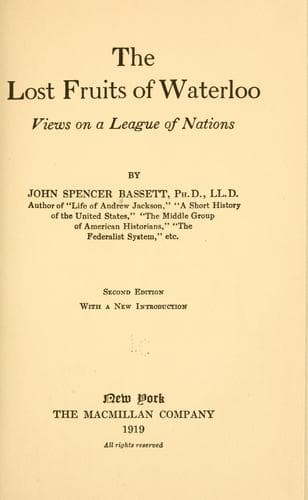
International cooperation; Peace; World War, 1914-1918
The first arose out of revolutions in Spain and Naples, where armed men
seized the power and forced the kings to accept liberal constitutions.
Alexander I and Metternich looked on with different feelings. The
former had been encouraging the liberals in Italy and was not greatly
shocked by the revolution there, but he was deeply concerned over
the upheaval in Spain and would have led a Russian army thither to
suppress it. The suggestion alarmed Metternich, who did not relish
the idea of Alexander’s marching through Austrian lands with a great
body of men. He did what he could to discourage the expedition against
Spain. At the same time he believed that Naples should be disciplined,
since its revolution endangered the safety of Austrian possessions in
Italy. It is amusing to see how self-interest ran across the currents
of the general good as proclaimed in the Concert of Europe.
The tsar thought the situation warranted calling another conference of
the Quintuple Alliance. Metternich objected, being chiefly concerned
by the seeming certainty that the tsar would wish to carry into the
situation his well-known views in support of liberalism. To him it
seemed sufficient that the powers should agree severally to give their
arms to the suppression of revolution, without meeting in conference.
After much discussion a conference was called, at Troppau, but it was
regularly attended by only three of the five powers. The suppression
of constitutional government was not popular in Great Britain, and
her government took no official part in the conference. France held
aloof also; she was so much under the protection of Great Britain that
she did not dare risk British displeasure by allying herself with the
forces of repression.
Did the absence of two nations from Troppau presage the dissolution of
the Alliance? Castlereagh gave a negative reply. His nation, he said,
was not bound beyond her treaty obligations, the terms of which were
clear and specific. They were embodied in the Treaties of Chaumont
and Paris. He considered the project of dealing with revolution in
its present form as beyond the meaning of these agreements. “If,”
he said, “it is desired to extend the Alliance so as to include all
objects present and future, foreseen and unforeseen, it would change
its character to such an extent and carry us so far, that we should
see in it an additional motive for adhering to our course at the risk
of seeing the Alliance move away from us without our having quitted
it.” These frank words show that the Alliance was strained but not
broken. It would seem that a system like that of which we speak should
have at bottom some broad common principles. In purpose it should
be harmonious. As between the prevailing British idea of liberty
and Metternich’s ideas of legitimacy there was no ground for mutual
support; and out of this divergence of views was to grow the disruption
of the Alliance, as we shall soon see.
Public-domain text, read in full here on John Shaqi.
Reviews
Reviews
No reviews yet
Be the first to share your thoughts on this work.
Join the Discussion
Join the discussion
Sign in to leave a comment or review.
Sign InorCreate an account