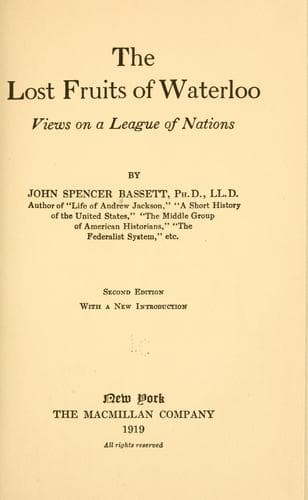
International cooperation; Peace; World War, 1914-1918
In 1821 the Greeks, also under the domination of Turkey, rose in
revolt. Great sympathy was aroused in the rest of Europe and in spite
of the disposition of the Great Powers to allow Turkey a free hand to
preserve her territory intact, lest one of them gain over-balancing
territory, public opinion forced them to intervene. The first to
show sympathy was Russia, who had an interest in making herself the
protector of the Christians in Turkey. The other powers resented
her assistance to the Greeks, and finally Great Britain and France
united in a project of intervention, sending a joint fleet to the
Mediterranean which destroyed the Turkish fleet at Navarino in 1827.
The stubborn sultan remained unyielding, and in 1828 Russia entered
the war openly, having come to an agreement with the other Powers. She
sent an army across the border which carried all before it, and the
sultan was forced to make the treaty of Adrianople, in which Turkey
recognized the independence of Greece and acknowledged Serbia as an
autonomous state under Turkish suzerainty. At the same time Wallachia
and Moldavia, where Rumans lived, were recognized as independent
under a Russian protectorate. Thus one sovereign and three dependent
but locally autonomous states stood forth out of the confused and
misgoverned Christian area of Turkey in Europe.
The rest of the region, occupied by Bulgars and Albanians, with Bosnia
and Herzegovina, claimed by the Serbs as legitimate parts of their
national habitat, remained in an unredeemed condition and were governed
by agents appointed by the sultan. Montenegro retained her position of
practical independence, which Turkey had been forced to acknowledge in
1799. These arrangements were confirmed in a more formal treaty in 1832.
The successes of this period quickened the spirit of nationality in
the Balkans. Just as the Greeks were swept by a wave of enthusiasm for
their classical culture and sought to revive the language and ideals of
the remote past, so the Balkan peoples set out to revive their ancient
culture, long obscured by the shadow of Turkish masters. Serbs, Rumans,
and Bulgars made grammars of their own languages, gathered up what was
preserved of their ancient literatures and traditions, taught their
children to revere the national heroes, and sought in many other ways
to stimulate the spirit of nationality. The Slavic portion turned
to Russia for support, whom they called their “big brother,” while
the Rumans cultivated an appreciation of Italy and France, whom they
considered kindred descendants of the ancient Romans. To their national
hopes in these things was added the desire for religious independence.
They disliked being under the ecclesiastical authority of the Patriarch
of Constantinople, who was appointed by the sultan, and looked forward
to a time when they might have exarchs of their own, with jurisdiction
not limited by the Patriarch.
Public-domain text, read in full here on John Shaqi.
Reviews
Reviews
No reviews yet
Be the first to share your thoughts on this work.
Elsewhere in the archive
Join the Discussion
Join the discussion
Sign in to leave a comment or review.
Sign InorCreate an account