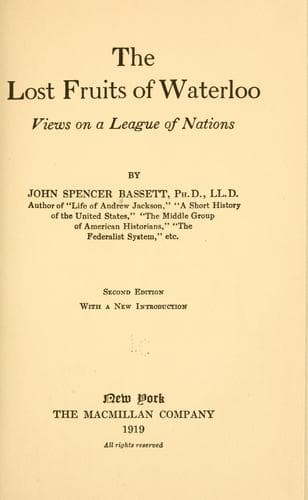
International cooperation; Peace; World War, 1914-1918
In 1854 Russia was ready for another advance in the region of the
Balkans, hoping to gain at last what Peter the Great had declared was
essential to her progress, a window looking out on the Mediterranean.
Great Britain and France came to the help of the sultan and the
Crimean War followed. After a hard struggle it ended in Russia’s
defeat, and at the Conference of Paris, 1856, the affairs of the
Balkans were again up for settlement, but this time the victory leaned
to the side of the Turk, although it was modified by the restraining
hand of his two allies. The purport of the treaty was to reduce the
power of Russia, and in doing so the aspirations of the Balkans
states were checked. The protectorate the tsar had established over
Wallachia and Moldavia was destroyed, and Bulgars, who had expected
independence, remained under the rule of the sultan, while Greece, who
had desired a large portion of Macedonia, was forced to continue in
her old boundaries. This crisis was not the last in which the vexed
Balkan question, seemingly near solution, was made to give way before
the complicated problems of the general European situation. Looking
backward we may well say that if Russia had secured her wish, expelled
the Turk from Constantinople and liberated the Balkan states, the
fortunes of France would not have been lessened, and Great Britain,
safe through her supremacy at sea, would not have lost any of the
strength she had in India. At the same time the sore spot of European
relations would have been healed, and we should probably have had no
war in 1914.
Wallachia and Moldavia were of the same stock and wished to unite as
one kingdom. They made their desires known in the negotiations that
resulted in the Treaty of Paris, but the Powers did not mean to create
a large state on the borders of Russia which might prove a bulwark
of influence for the tsar, and accordingly they denied the request.
The two states found a way to accomplish their desire, soon after the
conference at Paris adjourned. Meeting to select rulers each chose
Alexander John Cuza simultaneously, and after hesitating two years the
Powers acknowledged him as king. Thus was formed the united kingdom
of Rumania; and its formation illustrated a weak point in the Concert
of Europe. However much the Powers might interfere to prevent the
consummation of an act they considered dangerous, they would think
twice before trying to punish a Balkan state, since in doing so they
might set off an explosion in the very system they were working to keep
peaceful. Rumania understood this phase of the matter and took her
chances. Her firm course had its reward.
Public-domain text, read in full here on John Shaqi.
Reviews
Reviews
No reviews yet
Be the first to share your thoughts on this work.
Elsewhere in the archive
Join the Discussion
Join the discussion
Sign in to leave a comment or review.
Sign InorCreate an account