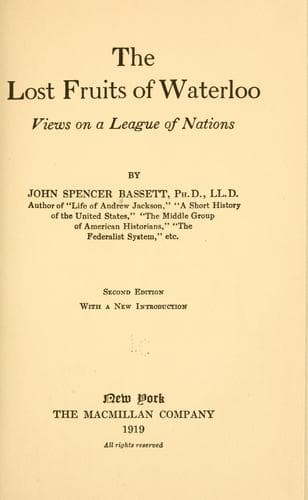
International cooperation; Peace; World War, 1914-1918
When we think of such things as these we are in danger of concluding
that they represent the real Germany. We look back to that Germany of
the past which we saw in our youth, whose music we have heard all our
lives, whose Goethe we have read, whose scholarship we have built upon,
and whose toys have amused us and our children through many decades
and ask ourselves whether or not we were mistaken in our ideas of
Germany. Are there two Germanies, and if so, which is the true Germany?
Probably the answer is that each is the real Germany manifesting
herself in different moods. Fundamentally we have an intense and
emotional people, swayed in one instance by artistic emotions, in
another by the love of exact research for facts, in another by the
feeling of domesticity, and in still another by the powerful impulse
of a great national egoism. They are a people who can love much,
hate much, play much, sacrifice much, and serve well when called
into service. In their war-maddened mood they have stained a fair
reputation, and they are now trying to think that the stain will not
matter if they can only fight through to victory. But nations are like
men in this that however successful one may become personally he never
gets to be so great that he can afford to carry a tarnished reputation.
Let us turn to the Germany of old and see if we cannot observe the
process by which she came to her present state of mind. While I realize
that it is absolutely necessary for the world to crush her attempt
to rule Europe, I cannot find it in my heart to hate her. She has
risen to such a state of efficiency in social organization and in the
capacity to spread the light of civilization that she commands respect
from thinking foes. It is the duty of the world to chasten the spirit
of arrogance out of her, but to leave her sound and able to deal with
the future in that way in which she is so well fitted to play a strong
and beneficial part. If ever a great people needed the discipline of
disaster to teach them that nations, like men, should do to others as
they wish others to do to them, that nation is the Germany of today. To
understand in what way this splendid state has run away from its past
we shall have to glance at its history in the recent past.
Public-domain text, read in full here on John Shaqi.
Reviews
Reviews
No reviews yet
Be the first to share your thoughts on this work.
Elsewhere in the archive
Join the Discussion
Join the discussion
Sign in to leave a comment or review.
Sign InorCreate an account