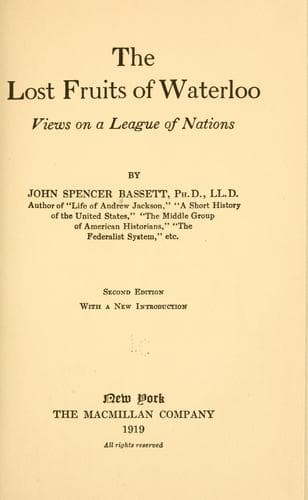
International cooperation; Peace; World War, 1914-1918
For a point of departure let us take the Seven Years’ War. This
struggle was the result of the ambition of young Frederick, a strong
and unethical king of Prussia. When he came to the throne he found
that a parsimonious father had left him a full treasury, an excellent
army, and a united kingdom, while fate had sent the neighboring state
Austria, a young woman for ruler and an army that was not formidable.
It was a favorable opportunity to seize Silesia, which Prussia
considered necessary to her welfare, and to which she had the flimsiest
pretense of right. The rapacity of Frederick, her king, cannot be
justified on moral grounds, and it threw Europe into commotions for
which nearly a quarter of a century was needed for settlement. The last
phase of this quarter-of-a-century was the Seven Years’ War, 1756-1763.
By the time it began Frederick of Prussia was looked upon by his
neighbors as a menace to Europe; and Austria, France, and Russia united
to crush him. He had a friend in Great Britain, who was generally found
among the foes of France. In the great war he waged through seven years
he fought off foes first on one side and then on the other until the
war ended at last with Prussia still unconquered.
If hard and valiant fighting and solicitude for the welfare of his
country could redeem the error of the invasion of Silesia the Seven
Years’ War would relieve Frederick, whom posterity calls “Frederick
the Great,” of all odium on account of the thoughtless way in which
he began his wars. Unlike the present kaiser, he began a long reign
rashly and ended it wisely. Administrative reforms and a policy of
peace with his neighbors made his last years a period of happiness for
Prussia.
But Silesia fixed a firm hold on the Prussian imagination. Long
justified as an act necessary to the safety of the Fatherland, and
therefore permissible, it has given sanction for the idea that wrong
may be done that good shall result, if only the state is to be
benefitted. It is a false doctrine, and it can do nothing but lead to
wars. Nations are under the same obligations to do right as individuals.
The next phase of German history which has interest for us in
connection with this study is that which lies between the years 1806
and 1813. It was a period of deep humiliation at the hands of Napoleon.
The small states were huddled together in a Confederation which was, in
fact, a tool of the Emperor of France, and Prussia lay like a trembling
and crushed thing in his hand. No living man who hates Germany for the
deeds of the present war could wish her a worse fate than Napoleon
inflicted on her after the battle of Jena in 1806. He insulted the
king, burdened the people with requisitions, and limited their armies.
It was the acme of national shame for the nation that is now so strong.
Public-domain text, read in full here on John Shaqi.
Reviews
Reviews
No reviews yet
Be the first to share your thoughts on this work.
Elsewhere in the archive
Join the Discussion
Join the discussion
Sign in to leave a comment or review.
Sign InorCreate an account