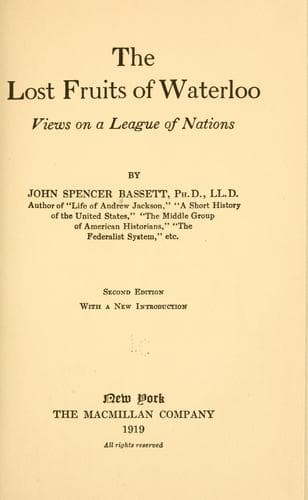
International cooperation; Peace; World War, 1914-1918
He had his reward. In 1866 he fought a decisive war against Prussia’s
old enemy, Austria, and won it so quickly that even the Prussians were
astonished. In 1870-1871 he threw the state against France in a war
that left the land of Napoleon as completely at his feet as Prussia had
been at the feet of the Corsican. And then in the moment of exultation
over the victory he founded the German empire by uniting with Prussia
the numerous smaller German states. There is much to support the
suggestion that a similar stroke is held in reserve to create a
Mittel-Europa of Germany and Austria-Hungary as a final glory of the
present war, if Germany shows herself able to carry off the victory.
Bismarck’s ambition for Germany was to hold a position of arbiter in
Continental affairs. He felt that this was the best way to make his
country safe from hostile combinations, and it met his ideal of the
dignity to which Germany ought to attain. He achieved his desire in
the Three Emperors’ League and the Triple Alliance. Predominance in
influence was the height of his ambition. The conquest of new lands,
and the support of industry and trade by a policy of territorial
expansion, were not within his plans. He was a man of an older
generation to whom a predominance among the Great Powers was better
than chasing the rainbow of world empire.
In 1888 died Wilhelm I, the king whom Bismarck made Emperor. He was
an honest man who loved the simple and sound Germany in which he
was reared. At this time the leading men of 1871 were passing from
power and a group was coming on the scene who were young men in the
intoxicating times of Sedan and Metz. A new emperor came to the throne,
possessing great energy and the capacity of forming vast plans. He was
eleven years old when the empire was proclaimed at Versailles, the age
at which ordinary boys begin to wake from the dreams of childhood.
From such dreams Wilhelm II passed to dreams of imperial glory. The
idea of bigness of authority that he thus formed has remained with him
to this day. Add the effects of an impulsive disposition and an unusual
amount of confidence in himself and you will account for the peculiar
gloss spread over a character that is strong and otherwise wholesome.
Early in his reign he gave ground for alarm by several acts that are
hardly to be described in a less severe word than “bumptious.” He
dismissed Bismarck from the Chancellorship, seemingly for no other
reason than that he wished a chancellor who would be more obedient to
the imperial will, and he uttered many sentiments which caused sober
men to wonder what kind of emperor he was going to be. But as the years
passed it was noticed that all his aberrations fell short of disaster,
and as he was very energetic and devoted to efficiency in civil and
military matters the world came at last to regard him with real esteem.
Public-domain text, read in full here on John Shaqi.
Reviews
Reviews
No reviews yet
Be the first to share your thoughts on this work.
Elsewhere in the archive
Join the Discussion
Join the discussion
Sign in to leave a comment or review.
Sign InorCreate an account