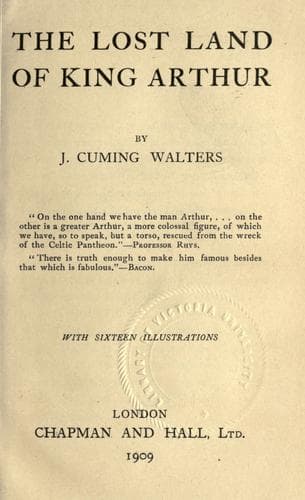
Arthur, King -- Homes and haunts -- England -- Cornwall (County); Cornwall (England : County) -- Antiquities, Celtic
was a fitting vehicle for certain moral and spiritual ideas.” Avalon,
lying not far from the western sea beyond which tradition said were
the happy isles of the blessed dead, was the Cymric equivalent for the
Celtic paradise, and thus did Glastonbury become associated with the
glorious legends which have made it in the eyes of the romancists the
most sacred and wondrous city of earth. So may Glastonbury truly be
said to gather round it “all the noblest memories alike of the older
and the newer dwellers in the land.” Nor is it surprising that in a
place of so much reputation modern marvels should be reported to occur
or wonderful discoveries be made. An elixir was found in the ruins of
the Abbey in 1586, one grain of which, being dropped upon an ounce and
a quarter of mercury, was found to transmute the mercury into an ounce
of pure gold. Another grain of it, dropped upon a piece of metal cut
out of a warming-pan, turned the metal into silver, and this with the
warming-pan was sent to Queen Elizabeth that she might “fit the piece
with the place where it was cut out.”
Such facts are worthy of being related at some length not only on
account of any curious interest they possess in themselves, but because
they enable us to understand a number of allusions in the Arthurian
story, and help to account for the selection of Glastonbury as the
scene of the most solemn episodes in the career of the British king and
his knights. The poet Spenser, in recording that Sir Lucius was the
first to receive “the sacred pledge of Christ’s evangely,” hastens to
recall the Glastonbury legend, and to explain that--
“Long before that day
Hither came Joseph of Arithmathy,
Who brought with him the Holy Grayle, they say,
And preacht the truth.”
All the chief points in the old beliefs and the myths and traditions
are caught up in Malory’s history. The account of Joseph and his coming
to England may be read in the Book of Sir Galahad, for the story was
told by the stainless knight who bore the marvellous shield--
Public-domain text, read in full here on John Shaqi.
Reviews
Reviews
No reviews yet
Be the first to share your thoughts on this work.
Elsewhere in the archive
Join the Discussion
Join the discussion
Sign in to leave a comment or review.
Sign InorCreate an account