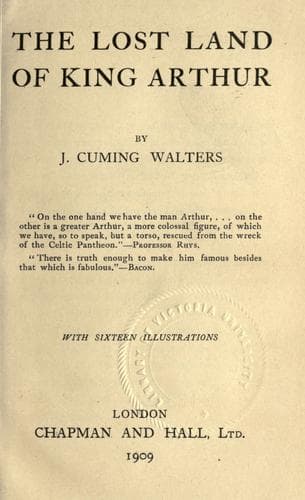
Arthur, King -- Homes and haunts -- England -- Cornwall (County); Cornwall (England : County) -- Antiquities, Celtic
the other, some of the blood which oozed from the crucified Saviour’s
body. The chalice, or sacred cup, was buried by Joseph at the spot
where a perpetual spring of water bubbles--the “Blood Spring,” which
supplies the Holy Well, scene of many miraculous cures in times past.
That the waters are medicinal admits of no doubt; that it issues from
the Cup is a matter of faith, especially as the Holy Grail is claimed
to be now in safe keeping by more than one far-distant Abbey.[32] As
for the second relic, it is said that St. Joseph confided the memorial
to his nephew Isaac, who sealed up the blood in two vials and secreted
them from the invading Roman pagans. When danger menaced him, he hid
the phials in an ancient fig-tree, which he then cast into the sea.
Carried by the waves to Gaul, the fig-tree was cast up at the spot
which now forms Fécamp harbour; and there a few centuries later it was
found with the two phials secure. Fearless Duke Richard of Normandy
was so impressed by the discovery that he built an Abbey in which
fitly to enshrine the Precious Blood, and Fécamp Abbey bears witness
alike to his faith and his devotion. It was upon the story of the
Grail that chroniclers seized with avidity after Borron had once shown
its capabilities--a story now believed by many to be almost wholly of
Celtic origin, the Sancgreal being none other than Fionn’s healing
cup. Mr. Nutt, to whose exhaustive work on the subject reference
has previously been made, has told us of every form, rudimentary
and developed, in which the Grail legend has appeared, and of every
explanation advanced as to its meaning. Whether the legend is based
upon Christian canonical or uncanonical writings, or whether it is an
ancient saga into which a Christian element was imported, whether it
was extant in any definite form before the time of Robert de Borron,
or whether it was a fabrication of the era to which many monkish
fables have been traced, are points which to discuss in detail would
require, and have had, volumes devoted to them. Within fifty years
(1180-1225) there were eight versions of the story in which the idea of
the Grail was elaborated, and we know how the idea has been developed
and enriched and idealised until our own time. “The vanished Vase of
Heaven that held like Christ’s own Heart an Hin of Blood,” has been a
marvellously fecund seed of inspiration to romancist and poet. Percival
and Galahad are the highest human conceptions of purity, and their
quest is the most exalting and ennobling upon which heroes can set
forth. Yet, as we have already seen, the conclusion cannot be resisted
that the story had its root in paganism, and that the history of the
Grail is nothing but the history of the gradual transformation of old
Celtic folk-tales into a poem charged with Christian symbolism and
mysticism. “This transformation, at first the inevitable outcome of its
pre-Christian development, was hastened later by the perception that it
Public-domain text, read in full here on John Shaqi.
Reviews
Reviews
No reviews yet
Be the first to share your thoughts on this work.
Elsewhere in the archive
Join the Discussion
Join the discussion
Sign in to leave a comment or review.
Sign InorCreate an account