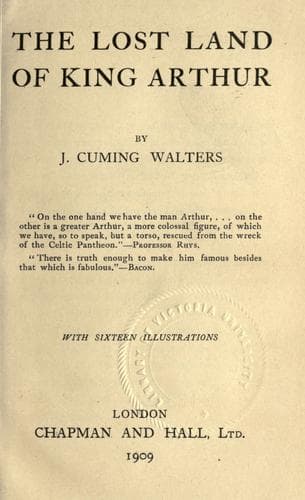
Arthur, King -- Homes and haunts -- England -- Cornwall (County); Cornwall (England : County) -- Antiquities, Celtic
Myrdin Emrys, the Welsh Merlin, is claimed as a native of Bassalleg,
an obscure town in the district which lies between the river Usk and
Rhymney. The chief authority for this is Nennius; but according to
others the birthplace was Carmarthen, at the spot marked by Merlin’s
tree, regarding which the prophecy runs that when the tree tumbles
down Carmarthen will be overwhelmed with woe. What we know of Merlin
in Malory’s chronicle is that he was King Arthur’s chief adviser, an
enchanter who could bring about miraculous events, and to whom was
delivered the royal babe upon a ninth wave of the ocean; a prophet who
foretold his sovereign’s death, his own fate, and the infidelity of
Guinevere; a warrior, the founder of the Round Table, and the wise
man who “knew all things.” Wales and Scotland alike claim as their own
this most striking of the characters in the Arthurian story. Brittany
also holds to the belief that Merlin was the most famous and potent of
her sons, and that his influence is still exercised over that region.
Matthew Arnold, gazing at the ruins of Carnac, saw from the heights he
clambered the lone coast of Brittany, stretching bright and wide, weird
and still, in the sunset; and recalling the old tradition, he described
how--
“It lay beside the Atlantic wave
As though the wizard Merlin’s will
Yet charmed it from his forest grave.”
The Scotch Merlin, Merlin Sylvester, or Merlin the Wild, was Merdwynn
of the haugh of Drummelziar, a delightful lowland region, where the
little sparkling Pausayl burn bickers down between the heather-clad
hills until it mixes its waters with the Tweed. He is said to have
taken to the woods of Upper Tweeddale in remorse for the death of his
nephew, though it is more likely that he lost his reason after the
decisive defeat of the Cymry by the Christians of the sixth century.
Sir Walter Scott records that in the _Scotichronicon_, to which work
however no historic importance can be ascribed, as it is notoriously a
priestly invention, is an account of an interview betwixt St. Kentigern
and Merdwynn Wyllt when he was in this distracted and miserable state.
The saint endeavoured to convert the recluse to Christianity, for he
was a nature-worshipper, as his poems show. From his mode of life he
was called Lailoken, and on the saint’s commanding him to explain his
situation, he stated that he was doing penance imposed upon him by
a voice from heaven for causing a bloody conflict between Lidel and
Carwanolow. He continued to dwell in the woods of Caledon, frequenting
a fountain on the hills, enjoying the companionship of his sister
Gwendydd (“The Dawn”), and ever musing upon his early love Hurmleian
(The Gleam), both of whom were frequently mentioned in his poems. His
fate was a singular one, and has been confused with that of the Merlin
of Arthur. He predicted that he should perish at once by wood, earth,
and water, and so it came to pass; for being pursued and stoned by the
Public-domain text, read in full here on John Shaqi.
Reviews
Reviews
No reviews yet
Be the first to share your thoughts on this work.
Join the Discussion
Join the discussion
Sign in to leave a comment or review.
Sign InorCreate an account