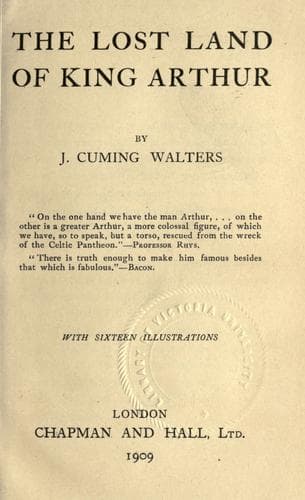
Arthur, King -- Homes and haunts -- England -- Cornwall (County); Cornwall (England : County) -- Antiquities, Celtic
Cornwall, the horn-shaped land, far removed from the great centres
of progress and industry, the land of giants, of a separate people
who until the last century spoke its own language;[15] the land
of holy wells and saints, of hut circles, dolmens, and earthwork
forts, memorials of extreme antiquity; the land of many stone crosses
indicating the early influence of Christianity; the land of so-called
giants’ quoits, chairs, spoons, punch-bowls, and mounds, sometimes the
work of primitive man, sometimes the work of fantastic Nature--this is
the land in which romance lingers and in which superstition thrives,
the land upon which seems to rest unmoving the shadow of the past.
Olden customs survive, the old fashion is not departed from. The
quaintness, the simplicity, the quietude, the charm of a bygone age may
be found yet in that part which Taylor, the water poet, described as
“the compleate and repleate Home of Abundance, noted for high churlish
hills, and affable courteous People.”
A tour through the land which romance has marked out for her own, and
where the fords, bridges, hills, and rocks are called after Arthur
or associated by tradition with his exploits, becomes easier every
year by the development of railways, little known in the wilder parts
until a decade or so ago. It must be sorrowfully confessed that the
visit to Tintagel, despite its charm, results in a certain amount
of disillusion. It contains no relic, nothing that can verily be
imagined a relic, of the old, old times when the flower of chivalry
ruled. As one walks down the solitary street and glances around he
sees that Tintagel is an antique, picturesque little place with its
quaint post-office of yore--battered by time, the roof fallen, and the
stonework disjointed--with its stunted cottages, its typical village
shop and hostelry, and its lonely church on the cliffs. Tintagel, as
it is, is unique, but it is not Arthurian unless we go direct to those
parts where Nature is not and never has been molested. The Pentargon
heights, the great gorges, the weird bays and caves, the rock-strewn
valleys, the imposing waterfalls--from these may be constructed the
scenery for the drama of the warlike king and his adventurous knights.
The huge bank of earth enclosing an oblong space, with its remnant of
stone-lining found near St. Breavard, is fitly called King Arthur’s
Hall. Such relics as are found in and near Tintagel are posterior to
King Arthur’s era. There is a Saxon cross to be seen, erected to the
memory of one Ælnat, a Saxon. A sybstel, or family pillar, with Saxon
inscription, found in Lanteglos Church, near Camelford, and a Roman
stone discovered in Tintagel churchyard, are ancient memorials of the
highest interest. Relics of the bronze age have been discovered also,
though the influence of the Phœnician tin-traders did not seemingly
extend to this mid part of Cornwall.
Public-domain text, read in full here on John Shaqi.
Reviews
Reviews
No reviews yet
Be the first to share your thoughts on this work.
Join the Discussion
Join the discussion
Sign in to leave a comment or review.
Sign InorCreate an account